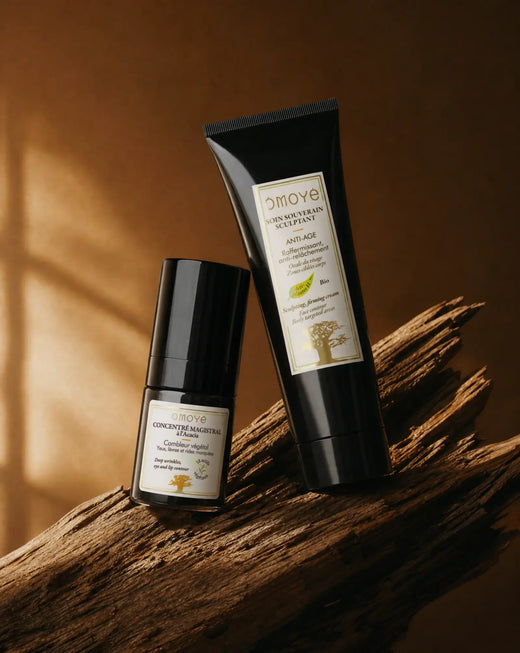
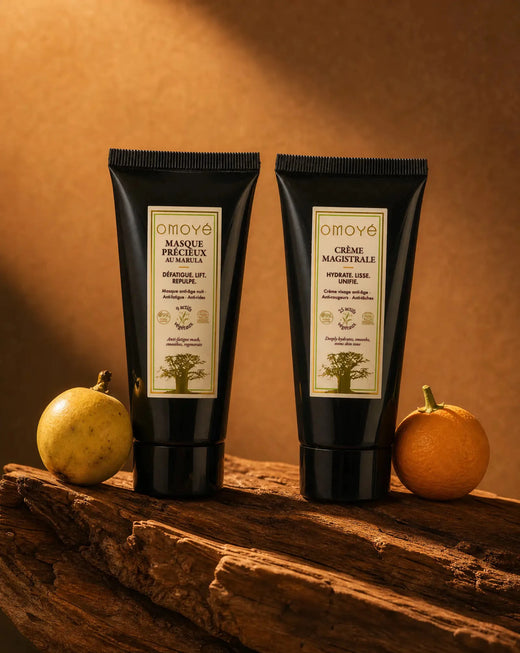
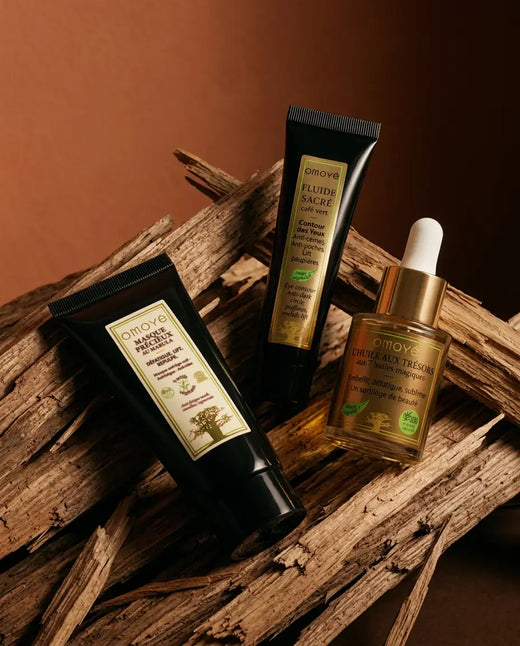

Les plus aimés
Pas sûre ?
Votre routine en deux minutes
Cinq questions sur votre peau, et nous vous disons quels soins lui conviennent. Gratuit, sans engagement.
Faire mon diagnosticOur rituals
Deux ou trois soins qui se répondent
Une association pensée pour un besoin précis, des soins choisis pour agir ensemble.
Tous les rituels Lequel pour moi ?
Buriti oil: benefits for skin and hair


Buriti oil (Mauritia Flexuosa Fruit Oil) is pressed from the orange pulp of the fruit of an Amazonian palm tree. Its color comes from its carotenoids: 440 to 1,480 mg of beta-carotene per kilo, a concentration ten times higher than that of red palm oil, accompanied by 1,300 to 2,400 mg of vitamin E. Rich in 65 to 78% oleic acid, it nourishes, softens, and gives the skin a golden veil. Evidence on the skin remains in the laboratory; no clinical trial has tested the oil alone. At OMOYÉ, it is included in the Vitamin-Rich Buriti Milk, the Beneficial Foraha Oil, and the Precious Marula Mask.
In short
- 65 to 78% oleic acid (omega-9), 16 to 18% palmitic acid, less than 2% linoleic acid: a very monounsaturated oil, similar to olive oil.
- 440 to 1,480 mg of beta-carotene per kilo of oil, or up to 95% of its carotenoids; its oil fraction contains ten times more than red palm oil.
- 1,300 to 2,400 mg of tocopherols (vitamin E) per kilo, with alpha and gamma being dominant.
- No published clinical trial tests buriti oil alone on the skin: the data are in vitro (human keratinocytes) and animal-based.
- Sensitive to oxidation: its peroxide value goes from 4.6 to 11 in 70 days; it should be stored away from light and heat.
Where does buriti oil come from?
The buriti, Mauritia flexuosa, is a palm tree native to the wetlands of northern South America: Brazil, Colombia, Venezuela, the Guianas, Ecuador, Peru, and Bolivia. It is called miriti or buriti in Brazil, moriche in Colombia and Venezuela, aguaje in Peru, morete in Ecuador, and bachê in French Guiana. Its scaly fruit contains an orange, fleshy, and oily pulp, from which the oil is extracted by pressing. It bears the INCI name Mauritia Flexuosa Fruit Oil.
The pulp is eaten and drunk in the Amazon, and the oil is used in folk medicine and by local industry in soaps, body moisturizers, and massage oils. Only one human trial has been published on buriti, and it is nutritional: in 44 deficient children, a pulp jam corrected the ocular signs of vitamin A deficiency in 20 days. That is the beta-carotene at work.
Why is buriti oil orange?
Because it is one of the vegetable oils richest in carotenoids. Four primary analyses published between 2016 and 2025 give 440 to 1,480 mg of beta-carotene per kilo of oil, or 44 to 148 mg per 100 g, with beta-carotene representing up to 95% of the carotenoids, accompanied by alpha-carotene. As early as 1989, the American Journal of Clinical Nutrition noted that its oil fraction is ten times more concentrated in beta-carotene than red palm oil. These levels vary by a factor of three depending on the batch, the maturity of the fruit, and the extraction method: we therefore cite ranges.
Beta-carotene is a provitamin A and an antioxidant; it first protects the oil itself from oxidation. The oil also provides 1,300 to 2,400 mg of tocopherols (vitamin E) per kilo, phenolic compounds, and an antioxidant capacity measured in the laboratory of 95 µmol of Trolox equivalent per gram.
What else does it contain?
| Fatty acid | Share of total fatty acids | What this means |
|---|---|---|
| Oleic (omega-9) | 65 to 78% | Nourishing, supple oil, similar to olive oil |
| Palmitic | 16 to 18% | Consistency, protective film |
| Linoleic (omega-6) | less than 2% | Little contribution to the barrier; to be combined with oils rich in linoleic acid |
| Alpha-linolenic | less than 1% |
With 78% monounsaturated fatty acids and less than 3% polyunsaturated ones, buriti oil is a comfort oil for dry skin, rather than a barrier oil. Its richness in carotenoids and unsaturated fats makes it sensitive to light, heat, and oxygen: in a storage study, its peroxide value rose from 4.6 to 11 in 70 days. In a formula, it is protected by vitamin E and an opaque bottle.
What do studies show on the skin?
| Study | Type | Result |
|---|---|---|
| Zanatta 2008 | In vitro, keratinocytes and fibroblasts | Emulsions with buriti oil are low-cytotoxicity even at high concentrations; adding vitamin E improves cell viability; "could be non-irritating" |
| Zanatta 2010 | In vitro, cells irradiated with UVA and UVB | Depending on the emulsion system, the oil reduces UV damage or, with certain ethoxylated surfactants, exacerbates it; authors' conclusion: an adjuvant role "especially in after-sun formulas" |
| Batista 2012 | Animal, 40 rats, 10% cream | Positive results on skin repair in animals; not transposable as a cosmetic claim |
| Pereira 2018 | In vitro, bacteria | The oil alone has no inherent antibacterial activity |
| Lozada 2025 | Clinical, multi-ingredient cream (aguaje, sacha inchi, physalis, Croton lechleri) | Improved firmness and viscoelasticity at 28 days, without irritation; effect not attributable to buriti oil alone |
The honest assessment: no published clinical trial, with a described protocol, tests buriti oil alone on human skin. The "+570% hydration" cited by some sites is unpublished supplier data, and the "SPF 4.9" that circulates has no source. What can be said: it is a nourishing oil, a source of provitamin A and vitamin E, well-tolerated in the laboratory, with a suggested benefit in after-sun care.
Does it protect from the sun? Does it make you tan?
No, and we prefer to say it clearly. No sun protection factor has been measured on the oil alone, and sun protection can only be claimed for a tested finished product. No study has measured any effect of topically applied buriti oil on melanin production either. What the oil provides is its color: its carotenoids deposit a golden, satin veil that brightens the complexion, and its vitamin E supports the skin after exposure. In the morning, a broad-spectrum SPF 30 sunscreen remains essential; in the evening, buriti oil has its place in a comfort milk or mask.
How to use it?
Rarely pure on the face: its color and richness in oleic acid destine it rather for measured formulas, body milks, masks, and blended oils, where it joins oils rich in linoleic acid, which nourish the skin barrier. On the body, a buriti milk can be applied morning or evening after showering, for suppleness and radiance, both before and after a day in the sun. Keep the bottles away from light and close them tightly.
Buriti oil for hair: what are the benefits?
The benefits of buriti oil for hair are due to the same composition as for the skin: an oil very rich in oleic acid, which coats and softens, accompanied by vitamin E and carotenoids that protect the oil itself from oxidation. On dry, dull, or summer-weary lengths, it provides suppleness, shine, and a softer feel. To be clear: the studies cited in this article concern the composition of the oil and skin cells; none were conducted on hair. What we describe here is based on usage, not measured results.
As an oil bath, before shampooing
This is the simplest gesture, and one that suits rich oils like buriti:
- Warm a few drops between your palms, on dry or slightly damp hair.
- Apply to the lengths and ends, avoiding the roots if your scalp greases quickly.
- Leave on for thirty minutes, or overnight under a towel, then perform your usual shampoo.
A small amount is enough. Its intense orange color can stain a pillowcase or light-colored towel: choose dark linens for the night. For dry ends, a single drop on dry hair is enough to tame them without weighing them down.
In a blend rather than pure
Pure, buriti oil is dense and highly colored. Diluted in other oils, it is easier to work with. This is the choice of the Beneficial Foraha Oil: nine organic vegetable oils, including buriti, foraha, baobab, and argan, designed for the face, body, and hair. The product sheet recommends it "as a mask" on hair; this is the oil bath described above, without having to measure it yourself. You will find other oils to mix with buriti in our articles on jojoba oil and baobab.
Vegetable buriti oil: how to recognize it?
- The INCI name: Mauritia Flexuosa Fruit Oil. This is the oil from the fruit pulp, the one that carries the carotenoids.
- The color: a deep red-orange. A pale oil has been refined or heavily diluted.
- The bottle: opaque or amber, because the oil oxidizes with light and heat.
- The scent: slightly fruity. A rancid smell signals an oxidized oil; do not use it anymore.
In which OMOYÉ products can you find buriti oil?
We read it in our INCI lists, under the name Mauritia Flexuosa Fruit Oil. It is the signature active ingredient of the Vitamin-Rich Buriti Milk, a satin body milk where it joins baobab seed oil. It is also included in the Beneficial Foraha Oil, a blend of nine oils for the face, body, and hair, in the Precious Marula Mask, a leave-on night mask, and in the Kalahari Cleansing Milk. The Healthy Glow Ritual combines the mist, the Treasure Oil, and the Buriti Milk. The botanical plate of the buriti is in the Shaman's Herbarium.
What the studies say
- Amazonian buriti oil: 65.6% oleic acid, 2,364 mg of tocopherols and 782 mg of beta-carotene per kilo, ORAC antioxidant capacity of 95.3 µmol of Trolox equivalent per gram. Speranza et al., Grasas y Aceites, 2016
- Buriti oil: 78.25% oleic acid, 1,549 µg of carotenoids per gram including 1,477 µg of beta-carotene, 129.5 mg of tocopherols per 100 g. Souto et al., Foods, 2025
- 70-day storage: carotenoids from 837 to 1,037 µg/g, peroxide value from 4.63 to 10.98 meq/kg; "carotenoids protect the oil from oxidative damage." Mesquita et al., Ciência Rural, 2020
- The oil fraction of buriti contains ten times more beta-carotene than red palm oil; in 44 children, a 20-day oral supplement corrected xerophthalmia. Mariath, Lima et Santos, American Journal of Clinical Nutrition, 1989
- Emulsions with buriti oil on keratinocytes and fibroblasts: low cytotoxicity, viability improved by vitamin E. Zanatta et al., Food and Chemical Toxicology, 2008
- Under UVA and UVB, the photoprotective potential of buriti emulsions depends on the surfactant system; the authors conclude it plays an adjuvant role, especially after-sun. Zanatta et al., Food and Chemical Toxicology, 2010
- Buriti oil alone has no inherent antibacterial activity (minimum inhibitory concentration greater than or equal to 1,024 µg/mL). Pereira et al., Pathogens, 2018
- 2022 review: the lack of in vivo evaluations and safety data on the bioactive compounds of buriti is highlighted. Barboza et al., Food Research International, 2022
- In mice, 90 days of oral buriti oil at 2,000 mg/kg showed no liver or food intake impairment. Marcelino et al., Nutrients, 2022
OMOYÉ buriti skincare
- Vitamin-Rich Buriti Milk: satin body milk with buriti oil and baobab oil, morning or evening after showering (€38 for 200 ml).
- Beneficial Foraha Oil: nine oils including buriti, for face, body, and hair, ideal after the sun (€53 for 100 ml).
- Precious Marula Mask: leave-on night mask where buriti joins marula and baobab (€49 for 50 ml).
- Healthy Glow Ritual: mist, Treasure Oil, and Buriti Milk: the three radiance gestures.
Dry skin or skin lacking radiance? The OMOYÉ skin diagnostic guides you in three minutes.
Sources
- Speranza P et al., "Amazonian buriti oil: chemical characterization and antioxidant potential", Grasas y Aceites, 2016
- Souto et al., "Buriti oil: chemical composition, carotenoids and antioxidant capacity", Foods, 2025
- Mesquita JA et al., "Buriti oil: fatty acids, carotenoids and stability during storage", Ciência Rural, 2020
- Marcelino G et al., "Safety of buriti oil after 90 days of oral administration in mice", Nutrients, 2022
- Mariath JG, Lima MC, Santos LM, "Vitamin A activity of buriti (Mauritia vinifera Mart) and its effectiveness in the treatment and prevention of xerophthalmia", American Journal of Clinical Nutrition, 1989
- Zanatta CF et al., "Low cytotoxicity of creams and lotions formulated with buriti oil (Mauritia flexuosa) assessed by the neutral red release test", Food and Chemical Toxicology, 2008
- Zanatta CF et al., "Photoprotective potential of emulsions formulated with buriti oil (Mauritia flexuosa) against UV irradiation on keratinocytes and fibroblasts cell lines", Food and Chemical Toxicology, 2010
- Batista JS et al., "Atividade antibacteriana e cicatrizante do óleo de buriti Mauritia flexuosa L.", Ciência Rural, 2012
- Pereira RLS et al., "Antibacterial and antibiotic-modifying activity of Mauritia flexuosa oil", Pathogens, 2018
- Pereira Freire JA et al., "Phytochemistry profile, nutritional properties and pharmacological activities of Mauritia flexuosa", Journal of Food Science, 2016
- Barboza NL et al., "Buriti (Mauritia flexuosa L. f.): an Amazonian fruit with potential health benefits", Food Research International, 2022
- Lozada et al., "Clinical evaluation of a cream containing Croton lechleri extract and Amazonian oils", Natural Product Communications, 2025
Questions fréquentes
L'huile de buriti tache-t-elle la peau ou les vêtements ?
Pure, elle est orange foncé et peut colorer temporairement la peau claire et les textiles. Dans un lait ou un masque, elle est dosée pour ne laisser qu'un voile doré. Laissez pénétrer quelques minutes avant de vous habiller.
Peut-on utiliser l'huile de buriti sur le visage ?
Oui, dans une formule dosée. Riche en acide oléique, elle convient surtout aux peaux sèches ou aux soins du soir. Chez OMOYÉ, le Masque Précieux au Marula et l'Huile Bienfaisante au Foraha l'associent à des huiles plus légères et riches en acide linoléique.
L'huile de buriti fait-elle bronzer ?
Aucune étude publiée ne montre qu'appliquée sur la peau elle stimule la mélanine. Son effet bonne mine vient de la couleur de ses caroténoïdes. Elle ne protège pas non plus du soleil : une protection solaire SPF 30 reste nécessaire.
L'huile de buriti est-elle bonne pour les cheveux ?
Elle assouplit et fait briller les longueurs comme toute huile riche en acide oléique, mais aucune étude ne l'a testée sur les cheveux. L'Huile Bienfaisante au Foraha, qui en contient, s'utilise en masque sur les longueurs et les pointes.
Quelle différence entre l'huile de buriti et l'huile de palme rouge ?
Les deux sont orange et riches en caroténoïdes, mais la fraction huileuse du buriti en contient dix fois plus, d'après l'American Journal of Clinical Nutrition. Le buriti vient d'un palmier de zones humides d'Amazonie, cultivé sans déforestation comparable à celle du palmier à huile.
Publié le 23 juillet 2024 · Mis à jour le 16 octobre 2026 · Par Elien Geneste


Comments