
Les plus aimés
Pas sûre ?
Votre routine en deux minutes
Cinq questions sur votre peau, et nous vous disons quels soins lui conviennent. Gratuit, sans engagement.
Faire mon diagnosticOur rituals
Deux ou trois soins qui se répondent
Une association pensée pour un besoin précis, des soins choisis pour agir ensemble.
Tous les rituels Lequel pour moi ?
Jojoba oil: skin benefits and usage


It comes from a desert shrub, it is called an "oil" even though it is a wax, and its dry texture makes it easy to wear. Jojoba oil is one of the most discreet yet useful active ingredients in natural cosmetics. Here is what it provides to the skin, for which skin types, and how to use it daily.
What is jojoba oil?
Simmondsia chinensis by its botanical name, the jojoba is a shrub from desert regions, sometimes called a "wild hazelnut." An oil with a dry texture, which has a particular affinity with the skin, is extracted from its seeds.
A little laboratory curiosity: from a chemical point of view, jojoba oil is not really an oil, but a liquid wax. This peculiarity explains its feel: it does not leave a greasy film and melts quickly into the skin, whereas other plant oils remain on the surface for longer.
The shrub grows in arid zones, where it withstands temperature fluctuations that few plants can tolerate. Its seeds resemble small hazelnuts, hence its nickname of wild hazelnut. The oil is extracted from these seeds by pressing, and it takes a lot to fill a bottle: it is a precious active ingredient, rarely dosed lightly in a formula.
Its main active components: omega-9s, including nervonic acid; palmitic acid, an important component of the skin's barrier; and unsaponifiables with antioxidant and protective properties.
The benefits of jojoba oil for the skin
It protects against dehydration
Jojoba is primarily a protector: it prevents and blocks skin dehydration. This makes it a good companion during difficult seasons, when wind, cold, and heating put a strain on the skin's comfort.
It deeply nourishes
Nourishing, it revitalizes the skin in depth. On a face that lacks oil, it provides comfort without the heaviness of a thick oil.
It helps rebalance sebum
This is its most well-known reputation: jojoba is rebalancing and regulates sebum secretion. It is for this reason that it is found in skincare for dry skin as well as in products intended for combination and oily skin.
It soothes
Soothing, jojoba calms irritations. An asset for skins that react quickly, those that redden after a treatment that is too rich or a day spent outdoors.
It maintains suppleness and elasticity
In terms of anti-aging, jojoba maintains the skin's suppleness and elasticity. Regenerating, it smooths and firms. This explains its place in anti-aging treatments as much as in comfort-oriented skincare.
For which skin types?
Jojoba oil has the elegance of being suitable for almost everyone. It is indicated for:
- sensitive skin, looking for a discreet emollient;
- mature skin, for suppleness and elasticity;
- dry and dehydrated skin, which it nourishes and protects;
- oily and combination skin, whose sebum it helps regulate.
If you are unsure about your skin type or which treatments are suitable for it, the Omoyé skin diagnosis will guide you with a few questions.
How to use jojoba oil daily
In natural cosmetics, jojoba is rarely used alone: it serves as a base for formulas where it carries and balances other active ingredients. At Omoyé, it is combined with plants that complement its action.
On the face
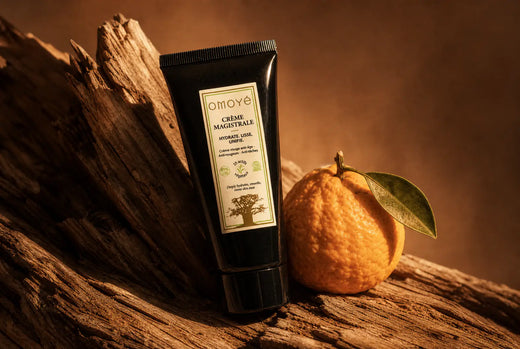
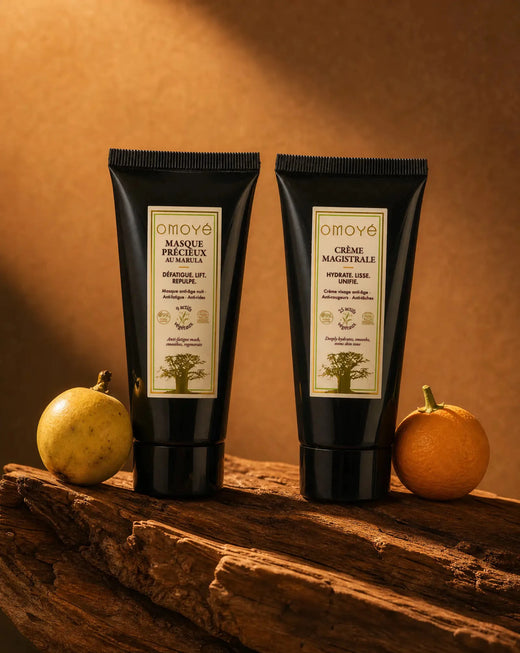
The Crème Magistrale is applied morning and evening, a small amount on the face and neck. Jojoba is paired with bitter orange and twenty-two other plant actives: the cream intensely hydrates and nourishes, smooths, and evens out the complexion.
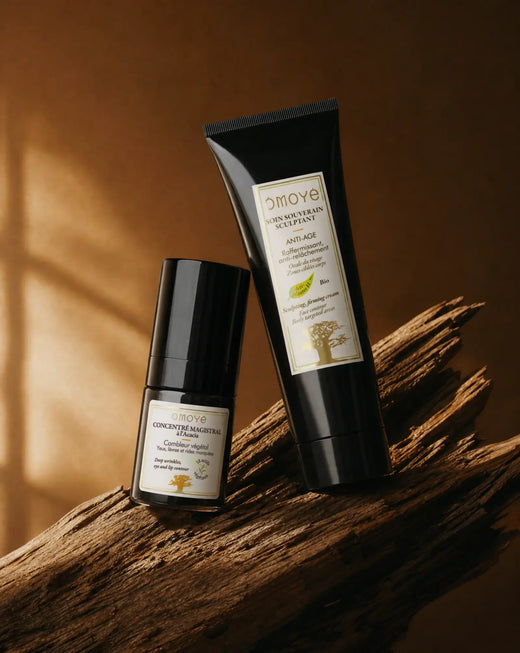
For deep wrinkles, the Concentré Magistral is applied last, after the cream, with a single drop on crow's feet, frown lines, or the contour of the mouth. Its totem tree is the acacia, but jojoba is part of its formula and contributes to its melting texture.
On the body
The Onguent Magistral is the treatment for which jojoba is the totem tree. It is a rich, nourishing, and restructuring body treatment with long-lasting hydration, designed for thirsty skin. It is used twice a week, or daily in case of intense dryness. We explained the difference between an ointment, a balm, and a cream in our article on the ointment.
As an SOS treatment
The Baume Magique also contains jojoba, among twenty-five plant active ingredients. It can be taken anywhere and applied locally on stressed areas, as an after-sun treatment, or in the evening for a restorative night.
Should it be used pure?
Pure jojoba oil can be found in bottles, and it works very well that way, a few drops warmed between the palms. But an oil alone only does one thing at a time. In a formula, it becomes the vehicle for other active ingredients: it carries plant extracts, it lightens butters, and it gives the texture that dry feel that makes all the difference during application. This is what we look for in our skincare products.
Jojoba, baobab, shea: how they complement each other
Natural formulas play on the complementarity of fatty substances. Shea butter provides the enveloping quality and richness. Baobab oil nourishes and protects. Jojoba provides lightness: it is often what makes a rich formula pleasant to wear, even on combination skin.
You can find the full list of products containing it on the Jojoba active ingredient page.
What to remember
- Jojoba is a liquid wax extracted from the seeds of a desert shrub, with a dry texture.
- It protects against dehydration, nourishes, soothes, helps regulate sebum, and maintains skin suppleness.
- It is suitable for sensitive, mature, dry, combination, and oily skin.
- At Omoyé, it is the totem tree of the Onguent Magistral and is used in the Crème Magistrale, the Concentré Magistral, and the Baume Magique.
A discreet active ingredient, then, which works mainly through its ability to fade behind others. This is perhaps why it is talked about less than baobab or shea, even though it is present in a large part of our formulas.
Publié le 20 septembre 2026 · Mis à jour le 29 septembre 2026 · Par Omoyé


Comments