
Les plus aimés
Pas sûre ?
Votre routine en deux minutes
Cinq questions sur votre peau, et nous vous disons quels soins lui conviennent. Gratuit, sans engagement.
Faire mon diagnosticOur rituals
Deux ou trois soins qui se répondent
Une association pensée pour un besoin précis, des soins choisis pour agir ensemble.
Tous les rituels Lequel pour moi ?
Cassava: skin benefits, from root to starch


Cassava nourishes hundreds of millions of people in Africa, Latin America, and Asia. It is less well-known in cosmetics, where it appears in the form of a very fine powder: its starch. Here is where cassava comes from, what cassava root and peel are, what its benefits for the skin are, and why it is found in an OMOYÉ eye contour treatment.
Cassava, a root from the Amazon
Cassava (Manihot esculenta) is a shrub in the spurge family. It is native to South America, where it has been cultivated for millennia in the Amazon basin. Portuguese navigators introduced it to Africa in the 16th century. It became one of the most important crops on the continent, and Nigeria is now the world's leading producer.
What is harvested are its tuberous roots: long tubers with brown bark and dense, white flesh. This flesh is very rich in starch. Dried and ground into a powder, this starch becomes tapioca, the flour and pearls known in cooking.
At OMOYÉ, cassava is one of the 39 active ingredients of "Magie Végétale". It is included in the formula under its INCI name: Tapioca Starch, which is cassava starch.
Cassava peel, root, starch: what are we talking about?
When looking for the benefits of "cassava peel," you come across three different things. It is better to distinguish between them.
- Cassava peel is the bark of the tuber: a thin brown film, and beneath it a thicker white or pinkish layer. It is removed before preparing the root.
- The root, or flesh, is the part that is eaten once peeled, soaked, and cooked.
- Cassava starch is extracted from this flesh. It is a white, fine powder that is soft to the touch. It is this, and this alone, that is used in skincare.
A point of caution: the peel and the raw root of cassava contain compounds that must be eliminated, and the peel contains more than the flesh. This is why the tuber is peeled, then soaked, fermented, or cooked before consumption. It is therefore not a material to be applied as is to the face, in a homemade mask for example. In cosmetics, we work with purified starch, which does not present this issue.
Cassava: the benefits of its starch for the skin
Cassava starch is not a "treating" active ingredient. It is a texture and feel ingredient, which is precisely what is expected of it. It provides three qualities to a skincare product:
- Lightweight: it helps skincare products spread easily without a greasy effect.
- Mattifying: it helps limit shine.
- Softening: it leaves the skin with a soft, velvety feel.
Why these effects? Starch grains are tiny particles that slip into the formula. Once the product is applied, they absorb a small amount of oil on the surface and diffuse light. The skin appears clearer, less shiny, and the feel becomes powdery without a sticky film.
This is an old piece of expertise. Long before synthetic powders, plant starches like rice starch were already used to soften and mattify the skin. Cassava starch follows this tradition.
For which skin types?
Cassava is suitable for all skin types and is indicated for mature skin. On skin that shows signs of aging, a light texture and a matte finish avoid the heavy effect sometimes dreaded with rich treatments. Combination skin, for its part, finds a clean feel.
Where can you find cassava at OMOYÉ?
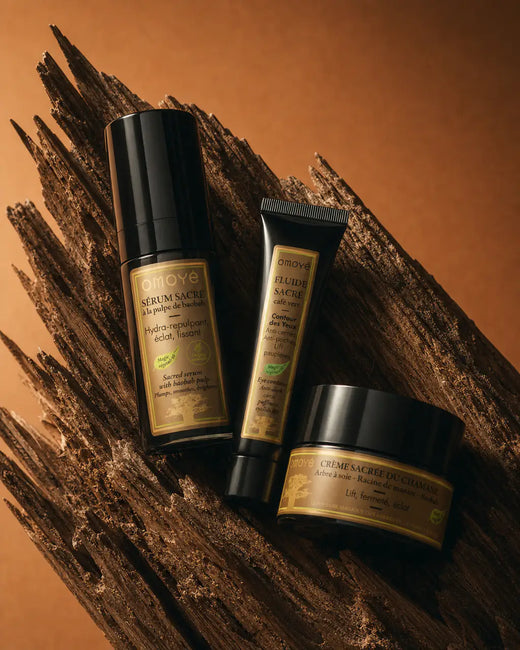
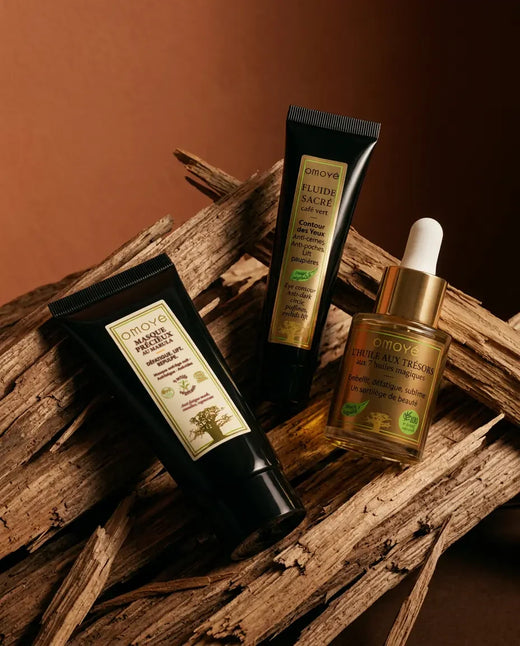
Cassava is included in the Fluide Sacré au Café Vert, the brand's eye and eyelid contour treatment. It is a good example of what starch brings: in an area as delicate as the eye contour, a treatment that is too rich can slide, highlight fine lines, or cause shine under makeup. The Fluid itself is described as a silky, non-greasy texture that melts in when patted on.
Cassava works behind the scenes. The active ingredients that define the treatment are elsewhere in the formula:
- green coffee, which gives the treatment its name;
- silk tree, which is found in several of the brand's treatments;
- baobab oil, borage, and evening primrose, which nourish the skin so it no longer feels tight.
Together, they put puffiness and dark circles to rest, with a tightening effect upon application. According to the product sheet: a rested look for 97% of users, reduced puffiness and dark circles for 88% (self-assessment satisfaction test, 35 consumers, 15 days). And a texture that makes a good makeup base, a matte finish to which cassava starch contributes. The Fluide Sacré comes in a 15 ml tube, for €38.
How to use it daily
The technique matters as much as the formula, especially on the eye contour.
- On clean skin, morning and evening, take a small amount of Fluid.
- Pat with the tip of your ring finger—the finger that applies the least pressure—onto the eye contour, not forgetting the corner and eyelids.
- Emphasize in the evening: it is at night, with water retention, that dark circles and puffiness form. Upon waking, repeat the motion if your eyelids are swollen.
- Let it penetrate for a few seconds before applying makeup: the matte finish helps the concealer stay in place.
To learn more about this area, read our article on natural eye contour care. And count on three weeks to judge a ritual: that is the time it takes for the skin to show what it has gained.
Frequently asked questions about cassava and the skin
Can you put cassava peel on your face?
It is not recommended. Cassava peel contains compounds that are eliminated in cooking through peeling, soaking, and boiling. In cosmetics, we only use cassava starch, which is extracted from the flesh and purified.
Are cassava starch and tapioca the same thing?
Yes. Tapioca is the starch extracted from the cassava root. On an ingredient list, it appears under the INCI name Tapioca Starch.
Is cassava suitable for oily skin?
Yes. Being mattifying, it helps limit shine, and its lightness avoids weighing the skin down. It is, in fact, suitable for all skin types.
Which treatment should I choose for my skin?
Cassava is only one of the active ingredients in "Magie Végétale." To find out which ritual corresponds to your skin, your age, and your needs, take the OMOYÉ skin diagnostic: it will recommend your treatments in just a few questions.
Publié le 16 octobre 2026 · Par Omoyé


Comments