
Les plus aimés
Pas sûre ?
Votre routine en deux minutes
Cinq questions sur votre peau, et nous vous disons quels soins lui conviennent. Gratuit, sans engagement.
Faire mon diagnosticOur rituals
Deux ou trois soins qui se répondent
Une association pensée pour un besoin précis, des soins choisis pour agir ensemble.
Tous les rituels Lequel pour moi ?
Foraha (tamanu) oil: what are the benefits for the skin, and what are the limitations?


Foraha, known as tamanu in Polynesia and calophyllum in French, is the tree Calophyllum inophyllum, whose nuts yield a thick, yellow-green oil with a nutty scent. Its distinctive feature: 10 to 20% resin, rich in calophyllolide and inophyllums, alongside a balanced profile of oleic and linoleic acids. In the laboratory, it stimulates the closure of keratinocyte "wounds" and the production of collagen in human fibroblasts; clinical evidence remains thin, and three cases of contact allergy have been published. It is traditionally applied to the skin in Madagascar and the Pacific. At OMOYÉ, it is included in the Beneficial Foraha Oil and the Magistral Concentrate.
In brief
- 10 to 20% of foraha oil is a resinous fraction, a unique signature among vegetable oils, with calophyllolide being the major compound in the 78 Pacific samples analyzed.
- Balanced profile: 20 to 49% oleic acid, 21 to 30% linoleic acid, 13 to 35% stearic acid depending on the origin.
- In vitro, at 0.1%, four tamanu oils closed a human keratinocyte "wound" by 68 to 95%, compared to 45% for olive oil.
- It absorbs UV rays with a maximum at 300 nm, but its clinically measured protection factor is only 6.3: it is not a sunscreen.
- Three cases of contact allergy have been published (2004 and 2022): a 48-hour patch test at the inner elbow is the best precaution.
What tree is the foraha?
Calophyllum inophyllum is an evergreen tree native to tropical shores: the coasts of East Africa from Kenya to Mozambique, Madagascar, the Comoros, the Seychelles, the Mascarene Islands, tropical Asia, northern Australia, and the Pacific Islands. Each region has given it a name: foraha or vintanina in Madagascar, tamanu in French Polynesia, kamani in Hawaii, dilo in Fiji, nyamplung in Java, punnai in India, mtondoo in Swahili, and calophyllum or Alexandrian laurel in French. In Polynesia, it is planted near marae, sacred sites.
Its oil has been applied to the skin for generations, in Polynesia as well as in the Seychelles, Mauritius, or Madagascar, for damaged, dry, or irritated skin, and for massage. These uses belong to traditional pharmacopeias; they explain where the oil's reputation comes from, not what a cosmetic product is permitted to claim.
How is the oil obtained, and why is it so unique?
The fruits, green nuts, are sun-dried for one to two months until the kernel turns brown and becomes impregnated with oil; it is then shelled and cold-pressed. The yield reaches 40 to 60% of the weight. The oil obtained is viscous, yellow to green, with a strong nutty scent: these are the signs of its resinous fraction.
This resin, 10 to 20% of the oil, is its signature among vegetable oils. It contains neoflavonoids and pyranocoumarins: calophyllolide, the major compound in all chemotypes analyzed across 78 samples from Fiji, New Caledonia, and Polynesia, as well as inophyllums, calanolides, and tamanolides. It is this fraction that provides the antioxidant power and the activity measured in the laboratory. "Calophyllic acid," often presented as a unique fatty acid, is actually a derivative of this resin described in 1953, for which no content level has been published.
| Fatty acid | Share of total fatty acids |
|---|---|
| Oleic (omega-9) | 20 to 49% depending on origin |
| Linoleic (omega-6) | 21 to 30% |
| Stearic | 13 to 35% |
| Palmitic | 15 to 17% |
A balanced profile, with a notable share of linoleic acid useful for the skin barrier, and saturated fatty acids that explain its consistency.
What do laboratory studies show?
| Study | Type | Result |
|---|---|---|
| Léguillier 2015 | In vitro, human keratinocytes, 5 oils from Indonesia, Tahiti, Fiji, and New Caledonia | At 0.1%, 68 to 95% closure of a "wound" compared to 45% for olive oil; activity carried by the resin, not by fatty acids |
| Ansel 2016 | In vitro, human dermal keratinocytes and fibroblasts, 1% emulsion | Cell proliferation, 10 to 40% higher collagen production, increased glycosaminoglycans |
| Said 2007 | In vitro, human epithelial cells | UV absorption with a maximum at 300 nm; at 1%, 85% inhibition of UV-induced DNA damage; non-cytotoxic up to 1% |
| Nguyen 2017 | Animal, isolated calophyllolide | Favorable results in mice; not transposable to a cosmetic product |
| Ogi 2026 | Clinical (protection factor) and in vitro | Measured SPF of 6.3 ± 0.4 and PA of 2.9 for Okinawa oil; calophyllolide and inocalophyllins active on inflammation mediators in vitro |
| Cassien 2021 | Chemistry and in vitro | 15 pyranocoumarins identified; resinous fractions protect cells from oxidative stress |
The conclusion: human evidence is limited to a protection factor measurement and a study on scars published in 2006, the details of which are not accessible. Everything else is in vitro or animal-based, and a 2021 review notes that no study has tested tamanu on atopic dermatitis. What can be said about a formula containing it: it nourishes, soothes tightness, and helps maintain skin in good condition, with laboratory evidence regarding collagen that remains to be confirmed in clinical settings.
Does it protect against the sun?
No. The oil absorbs part of UVB, with a maximum at 300 nm, and the 2007 in vitro measurement had raised hopes for a high factor. The clinical measurement published in 2026 puts things back in perspective: an SPF of 6.3, which is very insufficient for sun protection, and which in any case should only be claimed on a finished product tested according to the standard. Its place is after sun exposure, to nourish and soothe tight skin, never as a substitute for SPF 30.
What precautions should be taken with foraha oil?
- Allergy: three cases of contact allergy have been published, one in 2004 and two in 2022. The oil is therefore not "hypoallergenic." Before first use, test the product for 48 hours at the inner elbow.
- Dosage: pure, the oil becomes cytotoxic in the laboratory at concentrations above 7 to 19% depending on the samples. This is an argument for formulating it in a blend of oils rather than applying it pure over large areas.
- Freshness: its resin shortens its shelf life, and its nutty odor intensifies as it ages. Prefer freshly cold-pressed oil, stored in a cool place away from light.
- Sun: no phototoxicity studies have been published. Its coumarins are not the photosensitizing furocoumarins found in citrus fruits, but the lack of data is not proof: apply it in the evening instead.
In which OMOYÉ skincare products can foraha be found?
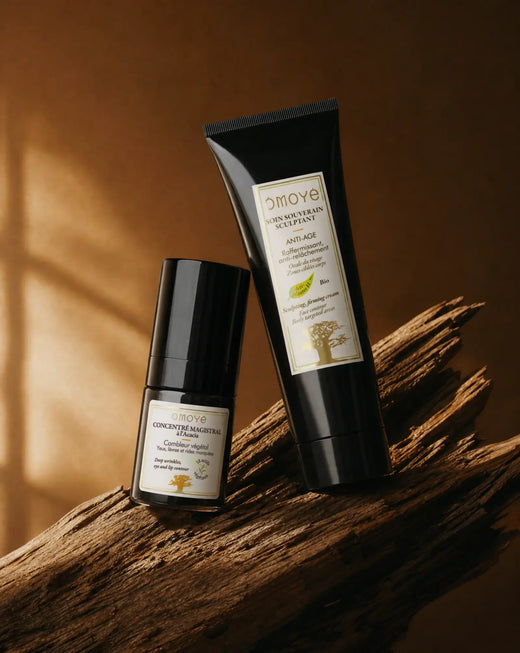
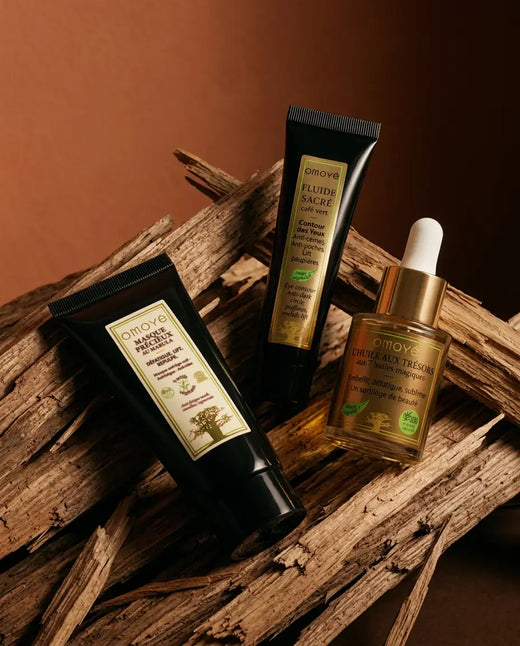
In the Beneficial Foraha Oil, Calophyllum inophyllum oil is dosed among nine oils: flax, argan, macadamia, jojoba, baobab, safflower, buriti, and evening primrose, protected by vitamin E. It is a dry oil for the face, body, and hair, appreciated after sun exposure, applied to slightly damp skin for better penetration. The Magistral Concentrate, a targeted treatment for marked wrinkles, also contains it, along with acacia and rosehip. The botanical plate of the foraha is in The Shaman's Herbarium.
What the studies say
- Five Calophyllum inophyllum oils on human keratinocytes: 68 to 95% "wound" closure at 0.1% compared to 45% for olive oil; antibacterial activity in vitro carried by the resin; cytotoxicity above 7 to 19% v/v. Léguillier et al., PLoS One, 2015
- Reference review on tamanu oil: composition (resin 10 to 20%, fatty acids), traditional Polynesian uses, in vitro data on collagen. Raharivelomanana et al., OCL, 2018
- Tamanu oil emulsion on human keratinocytes and fibroblasts: proliferation, production of glycosaminoglycans and collagen, "wound" closure activity. Ansel et al., Planta Medica, 2016
- UV absorption starting at 1/10,000 with a maximum at 300 nm; at 1%, 85% inhibition of UV-induced DNA damage on human cells; non-cytotoxic up to 1%. Said et al., European Journal of Pharmaceutical Sciences, 2007
- Clinical SPF of 6.3 ± 0.4 and PA of 2.9 for Okinawa tamanu oil; calophyllolide and inocalophyllins active in vitro. Ogi et al., Journal of Natural Medicines, 2026
- Calophyllolide is the major resin compound in the 78 samples from Fiji, New Caledonia, and French Polynesia analyzed. Ginigini et al., PeerJ, 2019
- Polynesian oil: resin 15 to 20%, 15 pyranocoumarins identified, resinous fractions protecting against oxidative stress in vitro. Cassien et al., Antioxidants, 2021
- 2021 review: no in vitro or in vivo study has directly evaluated tamanu for atopic dermatitis. Pribowo et al., Evidence-Based Complementary and Alternative Medicine, 2021
- One case of contact allergy to tamanu oil confirmed by patch test. Le Coz, Contact Dermatitis, 2004
- Two cases of contact allergy to tamanu oil. Amsler, Soria et Barbaud, Contact Dermatitis, 2022
OMOYÉ skincare with foraha
- Beneficial Foraha Oil: nine oils, for face, body, and hair; the brand's after-sun reference (€53 for 100 ml).
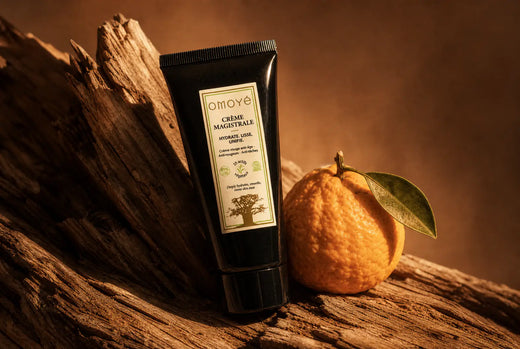
- Magistral Concentrate: targeted treatment for marked wrinkles, one drop as a final step (€69 for 15 ml).
- The Magic Balm: without foraha, but a companion for dry and stressed skin, to take everywhere.
Is your skin feeling tight, red, or easily heated? The OMOYÉ skin diagnostic will tell you which steps to prioritize.
Sources
- Léguillier T et al., "The wound healing and antibacterial activity of five ethnomedical Calophyllum inophyllum oils: an alternative therapeutic strategy to treat infected wounds", PLoS One, 2015
- Raharivelomanana P et al., "Tamanu oil and skin active properties: from traditional to modern cosmetic uses", OCL, 2018
- Ansel JL et al., "Biological activity of Polynesian Calophyllum inophyllum oil extract on human skin cells", Planta Medica, 2016
- Said T et al., "Cytoprotective effect against UV-induced DNA damage and oxidative stress: role of new biological UV filter", European Journal of Pharmaceutical Sciences, 2007
- Ogi T et al., "Anti-inflammatory and photoprotective constituents of tamanu oil", Journal of Natural Medicines, 2026
- Nguyen VL et al., "Anti-inflammatory and wound healing activities of calophyllolide isolated from Calophyllum inophyllum Linn", PLoS One, 2017
- Cassien M et al., "Polynesian tamanu oil: chemical composition and antioxidant properties of its resinous fractions", Antioxidants, 2021
- Ginigini J et al., "Chemodiversity of Calophyllum inophyllum L. oil from the South Pacific", PeerJ, 2019
- Fratianni F et al., "Fatty acid profile and antioxidant properties of Calophyllum inophyllum oil", Antioxidants, 2025
- Nhat et al., "Purification trials of tamanu (Calophyllum inophyllum) oil", OCL, 2021
- Pribowo A et al., "Potential of tamanu (Calophyllum inophyllum) oil for atopic dermatitis treatment", Evidence-Based Complementary and Alternative Medicine, 2021
- Le Coz CJ, "Allergic contact dermatitis from tamanu oil (Calophyllum inophyllum)", Contact Dermatitis, 2004
- Amsler E, Soria A, Barbaud A, "Two cases of allergic contact dermatitis to tamanu oil", Contact Dermatitis, 2022
Questions fréquentes
Foraha, tamanu, calophylle : est-ce la même huile ?
Oui. Foraha est le nom malgache, tamanu le nom polynésien, calophylle le nom français de Calophyllum inophyllum. Sur une étiquette, l'huile apparaît toujours sous son nom INCI, Calophyllum Inophyllum Seed Oil.
L'huile de foraha est-elle cicatrisante ?
C'est sa réputation traditionnelle, et des études en laboratoire montrent qu'elle stimule des cellules de peau. Mais aucun essai clinique accessible ne le confirme, et en Europe un cosmétique n'a pas le droit de se dire cicatrisant. Ce que nous disons de nos formules au foraha : elles nourrissent, apaisent les tiraillements et aident à maintenir la peau en bon état.
Peut-on utiliser l'huile de foraha pure sur le visage ?
Mieux vaut la formule dosée. Pure, elle est épaisse, très odorante et devient cytotoxique en laboratoire au-delà de quelques pour cent. Dans l'Huile Bienfaisante au Foraha, elle est mélangée à huit autres huiles pour rester légère et bien tolérée. Testez toujours 48 heures au pli du coude.
L'huile de foraha est-elle comédogène ?
Aucune donnée publiée ne le mesure. Sa consistance épaisse et sa part d'acides gras saturés invitent à la réserver aux peaux sèches ou à l'utiliser diluée sur les peaux mixtes.
Pourquoi l'huile de foraha sent-elle si fort ?
À cause de sa résine, 10 à 20 % de l'huile, qui lui donne son odeur de noix et sa couleur verte. Une odeur qui vire au rance signale une huile trop vieille : la résine raccourcit sa conservation, d'où l'intérêt d'un flacon récent gardé au frais.
Publié le 8 août 2024 · Mis à jour le 9 septembre 2026 · Par Elien Geneste


Comments