
Les plus aimés
Pas sûre ?
Votre routine en deux minutes
Cinq questions sur votre peau, et nous vous disons quels soins lui conviennent. Gratuit, sans engagement.
Faire mon diagnosticOur rituals
Deux ou trois soins qui se répondent
Une association pensée pour un besoin précis, des soins choisis pour agir ensemble.
Tous les rituels Lequel pour moi ?
Which natural plant-based cream is best for sensitive skin?


For sensitive skin, dermatologists recommend a cream with a short ingredient list, free of exfoliating acids or denatured alcohol, with few preservatives and surfactants, fragrance-free or with limited fragrance, and above all, tested on a small area before being adopted. "Natural" is not a criterion in itself: sensitive skin can react to botanical actives, and 28 of the 82 established contact allergens are natural extracts. The ingredients with clinical evidence are few and simple: glycerin, niacinamide, oils rich in linoleic acid, shea butter. At OMOYÉ, we tell you how many fragrance allergens are listed for each treatment, and we advise starting with those that contain the fewest.
In brief
- In France, 59% of people surveyed report having sensitive skin (66% of women, 52% of men); dry skin increases this risk by sixfold.
- Sensitive skin is not an allergy: it is a syndrome linked to the skin's nervous system, defined by a 2017 international consensus.
- Cosmetics are the primary declared triggering factor (odds ratio 7.12), ahead of air conditioning, heat, pollution, and cold.
- Among 197 patients, a cream with 20% glycerin caused a stinging sensation in 10% of them, compared to 24% for a cream with urea, with equal efficacy on dryness.
- Between 1% and 9% of Europeans are allergic to fragrance allergens; the list of substances to be labeled increases from 24 to approximately 80 for products placed on the market since July 31, 2026.
What is sensitive skin?
The authoritative definition comes from a 2017 international consensus, reached in five rounds among specialists: "a syndrome defined by the occurrence of unpleasant sensations (tingling, burning, pain, itching, pricking) in response to stimuli that should not normally provoke such sensations," with no skin lesions to explain it, on normal-appearing or reddened skin, most often on the face. It is not an allergy: the same expert group clarifies that "sensitive skin is not an immunological disease but is linked to alterations in the cutaneous nervous system." In 50 biopsies, the density of the finest nerve fibers was found to be lower in sensitive skin; in 21 patients, the pain threshold for heat was lowered. A weakened skin barrier is often associated, although a cause-and-effect link has not been established.
It is common. Of 5,000 French people surveyed in 2018, 59% reported sensitive or very sensitive skin, 66% of women and 52% of men, and more than 60% under the age of 35; dry skin multiplies this risk by six, light skin by nearly two. Among eight European countries, France and Italy lead the list. These are self-reported survey data, which may overestimate reality, but the order of magnitude has been consistent for twenty years.
What triggers the sensations?
In surveys compiled by the international expert group, people with sensitive skin point to the following triggers, expressed as odds ratios compared to non-sensitive skin: cosmetics 7.12; humid air 3.83; air conditioning 3.60; temperature variations 3.53; heat 3.50; water 3.46; pollution 3.18; dry air 3.04; cold 2.73; wind 2.33; sun 1.81; emotion 1.77. The experts add an honest caveat: these are based on patient viewpoints, and "there is no evidence of the involvement of these factors," except for a study on hair dyes. The French Society of Dermatology explains the mechanism of cold: vasoconstriction and a decrease in sebum, leading to drier and more reactive skin; below 40% humidity, the skin loses more water.
Cosmetics are the top trigger because they sometimes contain irritating substances: alpha-hydroxy acids, propylene glycol, alcohol, fragrances, preservatives, and surfactants. Hence the importance of choosing the right cream and testing it before adoption.
What dermatologists recommend for choosing a cream
- The international consensus (2020): "limit the use of cosmetics or use high-tolerance products containing few or no preservatives and surfactants, and no fragrance"; avoid exfoliating acids, propylene glycol, and alcohol; use a broad-spectrum SPF 30 sunscreen, noting that "sunscreens can also be sensitive skin triggers." No medication has proven effective: management relies on skincare.
- The French Society of Dermatology: for reactive skin, "avoid a certain number of ingredients, starting with fragrances"; "it is better to choose products without essential oils and test the product on a small area before applying it"; and this key phrase to remember: "sensitive skin can react to natural actives."
- The American Academy of Dermatology: stop using products containing alcohol, fragrance, and retinoids when skin is dry and reactive; prefer "fragrance-free" over "unscented," which may hide a masking agent.
Which ingredients have evidence, and what is it?
| Ingredient | What studies show | Level of evidence |
|---|---|---|
| Glycerin | In 197 atopic skin patients over 30 days, a 20% glycerin cream hydrated as well as a urea cream with fewer stinging sensations (10% vs 24%). A review confirms improved hydration and barrier function and "protection against irritant stimuli." | Double-blind randomized trial |
| Niacinamide (vitamin B3) | In 20 volunteers over 28 days, reduced water loss and thickened stratum corneum; in vitro, ceramide synthesis multiplied by 4 to 5. | Clinical, small sample size |
| Oils rich in linoleic acid (sunflower, safflower, borage, evening primrose) | In 19 adults, four weeks of sunflower oil preserved the barrier and improved hydration, whereas olive oil altered the barrier and reddened the skin. | Clinical, small sample size |
| Shea butter | Open study on 34 atopic children: improved itching and quality of life, with no difference compared to a product with ceramides. Recommended by the American Academy of Dermatology for dry skin. | Open clinical |
| Squalane | Stable emollient, hydrogenated form of sebum squalene; "non-comedogenic" according to the Cleveland Clinic; no clinical trials on sensitive skin. | Expert opinion |
| Bisabolol, allantoin | Anti-inflammatory effects in the laboratory or in animals; authors call for clinical trials. | Preclinical |
| Orange blossom water, neroli | Soothing effect shown in animals with the essential oil, which contains 28% linalool and limonene, two labeled fragrance allergens; no human studies on sensitive skin. | Animal |
The honest takeaway: the safe bets are the simplest ones—glycerin, oils rich in linoleic acid, and shea butter. "Soothing" extracts are often traditional or preclinical; they do not replace a tolerance test.
Natural does not mean risk-free: read the fragrance allergens
Fragrances, including those of plant origin, are the leading cause of contact allergy to cosmetics. The European scientific committee has established a list of 82 proven contact allergens in humans—54 molecules and 28 natural extracts—and estimates that 1% to 3% of the general population and 16% of eczema patients are sensitized to them; the 2023 regulation notes a range of 1% to 9% of Europeans. Since 2003, 26 of these substances (24 today, as two were banned) must appear in the INCI list at concentrations of 0.001% or higher in a cream; Regulation (EU) 2023/1545 adds 56 more, meaning approximately 80 substances and extracts must be declared for products placed on the market since July 31, 2026, with products already on shelves having until July 31, 2028.
In practice, everything can be read at the end of the INCI list, after the word Parfum: Linalool, Limonene, Geraniol, Citronellol, Citral, Benzyl Alcohol, Cinnamal, Coumarin, Eugenol. These molecules are the natural constituents of essential oils and floral waters. Their presence is not a flaw in the formula, it is information: the fewer there are, and the lower the dose, the more likely a reactive skin is to tolerate it well. Sensitive skin is not necessarily allergic; an allergy is diagnosed via patch tests by a dermatologist.
How to test a cream before adopting it?
- The home test, described by the American Academy of Dermatology: apply the product to a coin-sized area, on the inner arm or inside of the elbow, twice a day for 7 to 10 days, using the usual amount. Without redness, itching, or swelling, the product can be used on the face. The French Society of Dermatology advises the same: "test your tolerance first on a small, non-visible area."
- "Dermatologically tested" means, according to European doctrine, that the product has been tested on humans under the supervision of a dermatologist, for tolerance or efficacy based on the presentation; self-perception studies are not sufficient to claim this.
- "Hypoallergenic" does not mean zero risk: the claim is only permitted if the product "has been designed to minimize its allergenic potential," supported by evidence.
- In a consultation, the 5% lactic acid stinging test on the nasolabial fold, developed in 1977, identifies "stingers": 14% of the general population.
Which OMOYÉ treatment for sensitive skin?
Our formulas are scented with plants, using floral waters and essential oils; none are "fragrance-free," and we list every allergen as required by law. Rather than a promise, here are the facts, read from our INCI lists, to help you choose according to your reactivity.
| Treatment | Fragrance allergens listed | For whom |
|---|---|---|
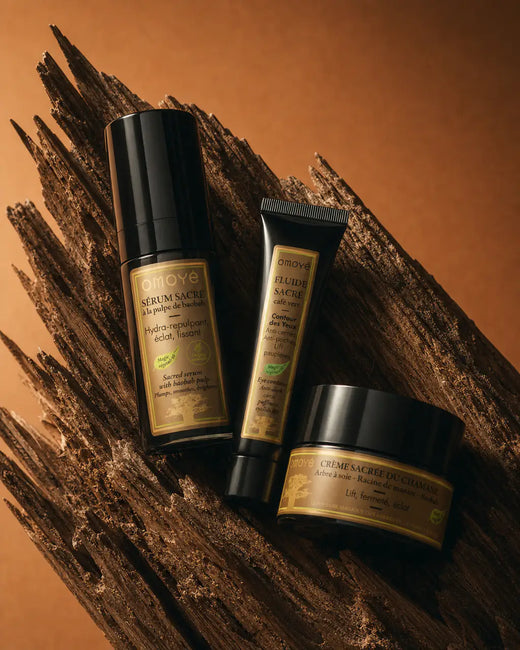
| Fluide Sacré au Café Vert (eye contour) | None: fragrance-free formula | Eye contour for all skin types, including the most reactive |
| Huile Bienfaisante au Foraha | Parfum, no allergens above the declaration threshold | Dry or heated skin, face and body, after sun exposure |
| Brume Bienfaisante d'Afrique | 1 (benzyl alcohol) | Toner and light hydration |
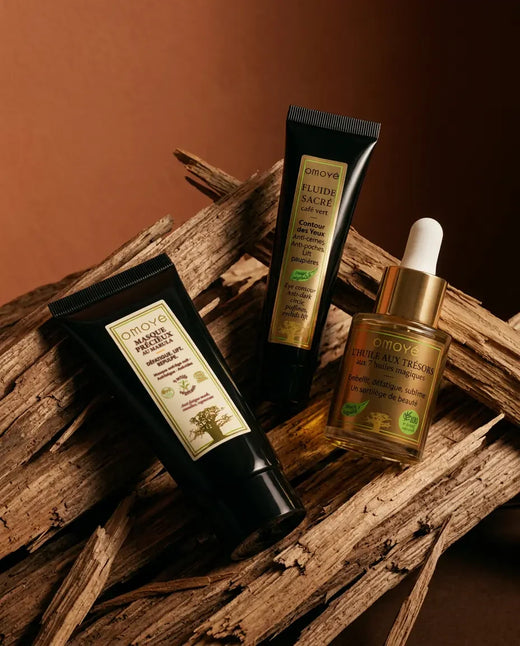
| Masque Précieux au Marula | 2 (benzyl alcohol, linalool) | Night mask for dry and tired skin |
| Le Baume Magique | 2 (citronellol, linalool) | Dry areas, tightness, SOS treatment |
| Huile aux Trésors | 2 (limonene, linalool) | Face, a few drops before cream |
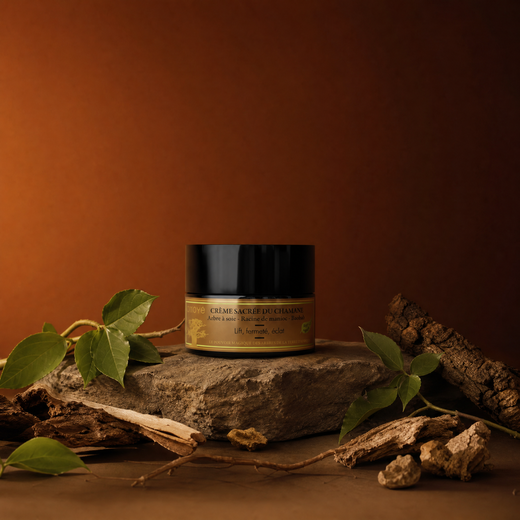
| Crème Sacrée du Chamane | 5 | Normal to combination skin that tolerates natural fragrances |
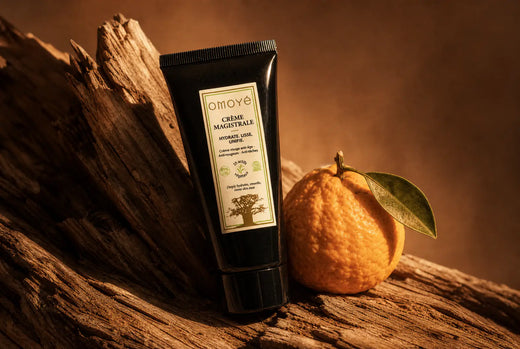
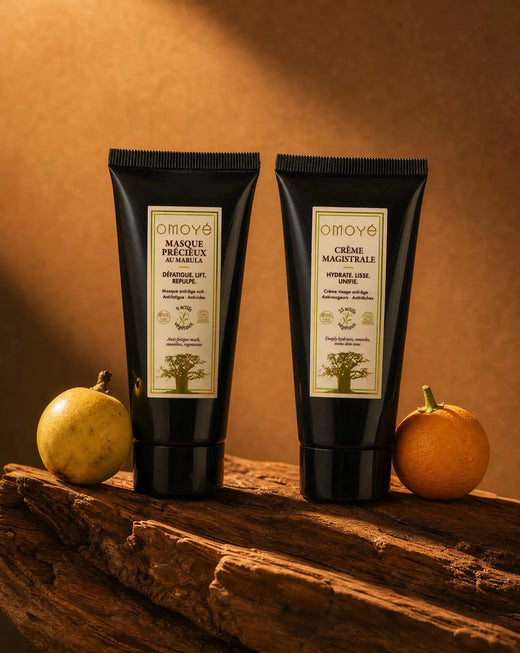
| Crème Magistrale | 9 | Dry and sensitive skin that tolerates natural fragrances: the richest formula in fatty substances and glycerin |
Crème Magistrale is the choice of most of our clients with dry and sensitive skin: its glycerin in third position, its borage, evening primrose, safflower, and flax oils rich in linoleic acid, its shea butter, aloe vera, and centella address the above recommendations point by point, without exfoliating acids or denatured alcohol. It is rated 4.8/5 from 415 verified reviews. However, it is scented, and nine allergens are listed: if your skin reacts to fragrances, start with the 7 to 10-day test on the inside of your elbow, or with a less-scented treatment from this list. The OMOYÉ skin diagnostic helps you determine your reactivity.
What the studies say
- Consensual definition of sensitive skin syndrome, obtained via a five-round Delphi method (at least 75% agreement among experts). Misery et al., Acta Dermato-Venereologica, 2017
- International position paper: sensitive skin is not immunological; declared triggers (cosmetics 7.12, pollution 3.18, cold 2.73); recommendation for fragrance-free products with few preservatives and surfactants. Misery et al., Journal of the European Academy of Dermatology and Venereology, 2020
- Survey of 5,000 French people: 59% report sensitive skin (66% of women, 51.9% of men); dry skin, odds ratio 6.18. Misery et al., Journal of the European Academy of Dermatology and Venereology, 2018
- Eight European countries, 4,506 people: 38.4% have sensitive or very sensitive skin, France and Italy in the lead. Misery et al., Journal of the European Academy of Dermatology and Venereology, 2009
- In 50 biopsies, lower density of intra-epidermal nerve fibers in sensitive skin. Buhé et al., Acta Dermato-Venereologica, 2016
- 197 atopic patients, 30 days: 20% glycerin cream, stinging in 10% vs 24% with urea, equal efficacy on dryness. Lodén et al., Acta Dermato-Venereologica, 2002
- 20 volunteers, 28 days of niacinamide: reduced water loss, thicker stratum corneum. Mohammed et al., International Journal of Pharmaceutics, 2013
- 19 adults, 4 weeks: sunflower oil preserves the barrier and improves hydration, olive oil alters the barrier. Danby et al., Pediatric Dermatology, 2013
- 34 atopic children, shea extract cream, 4 weeks: improved pruritus and quality of life, no difference with a ceramide product. Hon et al., Hong Kong Medical Journal, 2015
- 82 established contact allergens in humans, including 28 natural extracts; 1% to 3% of the general population and 16% of eczema patients sensitized to fragrances. Scientific Committee on Consumer Safety, opinion SCCS/1459/11, 2012
- 56 fragrance allergens added to the existing 24; thresholds of 0.001% (rinse-off) and 0.01% (leave-on); 1% to 9% of Europeans allergic; application July 31, 2026, and July 31, 2028. Commission Regulation (EU) 2023/1545 (EUR-Lex)
OMOYÉ treatments to discover first when skin is reactive
- Fluide Sacré au Café Vert: our only fragrance-free treatment, for the eye contour (€38 for 15 ml).
- Le Baume Magique: two listed allergens, shea, baobab, and 23 other actives for areas that feel tight (€34 for 50 ml).
- Masque Précieux au Marula: leave-on night mask, two listed allergens (€49 for 50 ml).
- Crème Magistrale: the rich cream for dry and sensitive skin that tolerates natural fragrances, after a 7 to 10-day test (€54 for 50 ml).
Unsure if your skin is sensitive, dry, or both? The OMOYÉ skin diagnostic helps you determine this in three minutes.
Sources
- Misery L et al., “Definition of sensitive skin: an expert position paper from the special interest group on sensitive skin of the International Forum for the Study of Itch,” Acta Dermato-Venereologica, 2017
- Misery L et al., “Pathophysiology and management of sensitive skin: position paper from the special interest group on sensitive skin of the International Forum for the Study of Itch,” JEADV, 2020
- Misery L et al., “Prevalence and management of sensitive skin in France”, JEADV, 2018
- Misery L et al., “Sensitive skin in Europe”, JEADV, 2009
- Chen W, Dai R, Li L, “The prevalence of self-declared sensitive skin: a systematic review and meta-analysis”, JEADV, 2020
- Buhé V et al., “Pathophysiological study of sensitive skin”, Acta Dermato-Venereologica, 2016
- Huet F et al., “Sensitive skin is a neuropathic disorder”, British Journal of Dermatology, 2018
- Wollenberg A, Giménez-Arnau A, “Sensitive skin: a relevant syndrome, be aware”, JEADV, 2022
- Lodén M et al., “A double-blind study comparing the effect of glycerin and urea on dry, eczematous skin in atopic patients”, Acta Dermato-Venereologica, 2002
- Fluhr JW, Darlenski R, Surber C, “Glycerol and the skin: holistic approach to its origin and functions”, British Journal of Dermatology, 2008
- Tanno O et al., “Nicotinamide increases biosynthesis of ceramides as well as other stratum corneum lipids to improve the epidermal permeability barrier”, British Journal of Dermatology, 2000
- Mohammed D et al., “Influence of niacinamide containing formulations on the molecular and biophysical properties of the stratum corneum”, International Journal of Pharmaceutics, 2013
- Danby SG et al., “Effect of olive and sunflower seed oil on the adult skin barrier”, Pediatric Dermatology, 2013
- Hon KL et al., “Efficacy and tolerability of a lipid complex cream with shea butter extract in children with atopic dermatitis”, Hong Kong Medical Journal, 2015
- Khodabakhsh P, Shafaroodi H, Asgarpanah J, “Analgesic and anti-inflammatory activities of Citrus aurantium L. blossoms essential oil (neroli) in mice”, Journal of Natural Medicines, 2015
- Scientific Committee on Consumer Safety, SCCS opinion SCCS/1459/11 on fragrance allergens, 2012
- Commission Regulation (EU) 2023/1545 of 26 July 2023 (fragrance allergens, EUR-Lex)
- Technical document on cosmetic claims, European Commission working sub-group, July 3, 2017 version
- American Academy of Dermatology, “How to test skin care products”
- Dermato-Info, French Society of Dermatology, “How to use cosmetics correctly”, 2019
- Frosch PJ, Kligman AM, “A method for appraising the stinging capacity of topically applied substances”, Journal of the Society of Cosmetic Chemists, 1977
Questions fréquentes
Peau sensible et peau allergique, est-ce la même chose ?
Non. La peau sensible est un syndrome lié aux nerfs de la peau, qui réagit à des stimuli anodins par des picotements ou des brûlures, sans lésion. L'allergie de contact est une réaction immunitaire à une substance précise, diagnostiquée par des tests épicutanés chez un dermatologue. Une peau sensible n'est pas forcément allergique, et inversement.
Une crème bio ou naturelle est-elle forcément plus douce ?
Non. La Société Française de Dermatologie rappelle qu'une peau sensible peut réagir aux actifs naturels, et 28 des 82 allergènes de contact établis sont des extraits de plantes. Ce qui compte : une formule courte, sans acides ni alcool dénaturé, un parfum limité, et un test sur une petite zone avant l'adoption.
Comment savoir si ma peau est sensible ?
Si elle picote, chauffe ou tire en réponse à l'eau, au froid, à la climatisation ou à des cosmétiques ordinaires, sans lésion visible, elle correspond à la définition du syndrome. Un dermatologue peut le confirmer par un test au picotement à l'acide lactique. Notre diagnostic de peau en ligne vous aide à situer votre réactivité.
Faut-il éviter les huiles essentielles quand on a la peau sensible ?
La Société Française de Dermatologie conseille de préférer des produits sans huiles essentielles pour les peaux réactives, parce que leurs constituants (linalol, limonène, géraniol) sont des allergènes de contact reconnus. Nos soins sont parfumés aux plantes : commencez par ceux qui listent le moins d'allergènes et testez-les 7 à 10 jours au pli du coude.
Quel test faire avant d'adopter une crème ?
Le test maison décrit par l'American Academy of Dermatology : appliquer la crème sur une zone de la taille d'une pièce, au pli du coude ou sur la face interne du bras, deux fois par jour pendant 7 à 10 jours. Sans rougeur, démangeaison ni gonflement, vous pouvez l'utiliser sur le visage.
Publié le 11 septembre 2024 · Mis à jour le 9 septembre 2026 · Par Elien Geneste


Comments
Anonymous —
Si y a bien une crème que je ne changerai jamais c’est celle-ci. J’ai toujours eu la peau qui tiraille en millieu de journée – depuis que j’ai la crème magistrale je n’en remet que le soir – en plus l’odeur et la sensorialite est top !
Jeanne —
Je l’utilise depuis 2 ans et je n’en ai jamais trouvé une autre qui fasse le même effet. La peau reste hydraté toute la journée, aucun problème de picotement sur ma peau sensible. J’y reviens tout le temps !