Les plus aimés
Pas sûre ?
Votre routine en deux minutes
Cinq questions sur votre peau, et nous vous disons quels soins lui conviennent. Gratuit, sans engagement.
Faire mon diagnosticOur rituals
Deux ou trois soins qui se répondent
Une association pensée pour un besoin précis, des soins choisis pour agir ensemble.
Tous les rituels Lequel pour moi ?
Silk tree (Albizia julibrissin): what is the use of bark extract in cosmetics?


Silk tree bark extract (INCI name: Albizia Julibrissin Bark Extract) is a cosmetic active ingredient used to combat signs of fatigue on the face and eye area: dark circles, puffiness, drawn features, and loss of firmness. Its value lies in glycation, the reaction between sugars and collagen and elastin fibers that stiffens the skin with age: in its manufacturer's tests, the extract helps limit its visible effects. At OMOYÉ, it is the sixth ingredient in our Crème Sacrée du Chamane and the fifth in our Fluide Sacré au Café Vert, our eye contour treatment.
In brief
- The bark of Albizia julibrissin, known as He Huan Pi, is included in the Chinese Pharmacopoeia; its medicinal use in China has been documented since 25 AD.
- Approximately 140 compounds have been isolated from the bark and flowers; the bark is particularly rich in lignans and triterpene saponins, known as julibrosides.
- In vitro, the extract reduces carboxymethyl-lysine, a marker of glycation, by 43% in skin fibroblasts subjected to sugar-induced stress (data from the active's manufacturer).
- In a study of 24 volunteers over 2 months, the blue component of dark circles decreased by 8.2%, compared to a 4.1% worsening in the placebo group (same source).
- No independent skin studies have been published to date: PubMed returns no articles linking Albizia julibrissin to skin. We mention this because it is true.
Where does the silk tree come from?
The silk tree, Albizia julibrissin, is a tree of the Fabaceae family native to Southwest and East Asia: Iran, Azerbaijan, China, and Korea. Its species name comes from the Persian "gul-i abrisham," meaning "silk flower," for its pink, silky tassels that bloom all summer; the genus is named after the Florentine nobleman Filippo degli Albizzi, who brought it to Europe in the mid-18th century. It is also known as the Constantinople mimosa. It grows to between 5 and 16 meters tall and has become naturalized in Africa and North America.
In traditional Chinese medicine, its dried stem bark, He Huan Pi, and its flowers, He Huan Hua, are two distinct substances in the Pharmacopoeia, historically used for mood and sleep. These uses fall under pharmacopoeia, not cosmetics; what is of interest for the skin is the composition of the bark.
What does albizia bark contain?
Phytochemical studies have isolated approximately 140 compounds from the bark and flowers. The bark is primarily concentrated in lignans (pinoresinol, syringaresinol, lariciresinol, secoisolariciresinol) and triterpene saponins, the julibrosides; flavonoids are mostly found in the flowers. A 2020 study isolated 26 lignans and phenols from the stem bark alone, several of which inhibit the production of nitric oxide, a mediator of micro-inflammation, in vitro.
No published source provides a percentage content of saponins or flavonoids in the bark; the active's manufacturer standardizes its extract to 2% albizzin, an amino acid. The extract appears in INCI lists under the name Albizia Julibrissin Bark Extract, often accompanied by glycerin.
What is glycation, and why does the eye area betray it?
Glycation is a chemical reaction between sugars present in tissues and the skin's supporting proteins, collagen and elastin. It forms advanced glycation end-products, or AGEs, which stiffen and disrupt these fibers: the skin loses its suppleness and the complexion becomes dull. Glycated fibers also maintain micro-inflammation around small vessels, which become more permeable; fluids accumulate where the skin is thinnest, under the eyes. This is the mechanism described by the active ingredient manufacturer's patent to explain dark circles and certain types of puffiness.
The albizia bark extract is presented therein as "de-glycating," meaning it is capable of reducing already-formed AGEs, and as a protector of the cell's defense systems against reactive sugars.
What do tests on albizia bark extract show?
All available skin data comes from the active's manufacturer, Sederma, and appears in its US patent US 9 737 476 B2. We report them as is, along with their nature.
| Test | Method | Result |
|---|---|---|
| Glycation marker | In vitro, human skin fibroblasts exposed to methylglyoxal | Carboxymethyl-lysine reduced by 43% compared to untreated stressed cells |
| AGEs in the skin | Human skin explants (5 donors), cream applied for 4.5 days | AGE labeling reduced by 23.4% compared to the placebo cream |
| Dark circle color | Clinical, 24 volunteers, 2 months, measurement on photographs | Blue component of dark circles decreased by 8.2%, compared to 4.1% worsening under placebo |
| Dermal firmness | Instrumental clinical (Reviscometer), 20 volunteers, 2 months | Slackening reduced by 44%, 80 to 85% of responders |
| Facial fatigue | Self-assessment, 20 volunteers, 2 months | Puffiness down 37%, dark circles down 40%, drawn features down 51% |
| Eye area fatigue | Self-assessment, 28 days | 42 to 46% decrease across four criteria (fatigue, dark circles, puffiness, fine lines) |
Combined with darutoside, the extract forms an eye contour active tested by the same manufacturer on 105 volunteers over 2 months: the surface area of drooping eyelids was reduced by "up to" 61% and the fold height by "up to" 91%. These are maximums, not averages, and the study is not published in a peer-reviewed journal.
The limitation is clear: as of September 8, 2026, no independent study has been published on the skin effect of this extract, and a "Milani 2014" reference cited by several brand websites cannot be found in scientific databases. The manufacturer's data is consistent and quantified; however, it remains the manufacturer's data. The active ingredient is generally used at 1 to 3% in a formula.
Is it well-tolerated?
No irritation or sensitization data has been published on the extract itself, and the Cosmetic Ingredient Review has not yet evaluated this ingredient. Bark saponins have shown a "slight hemolytic effect" in the laboratory in an injectable context in mice, which is unrelated to use on the skin. Tolerance is therefore judged based on the finished product, which is tested before it is marketed; as with any skincare, a 48-hour patch test on a small area remains the right reflex for reactive skin.
In which OMOYÉ skincare products can silk tree be found?
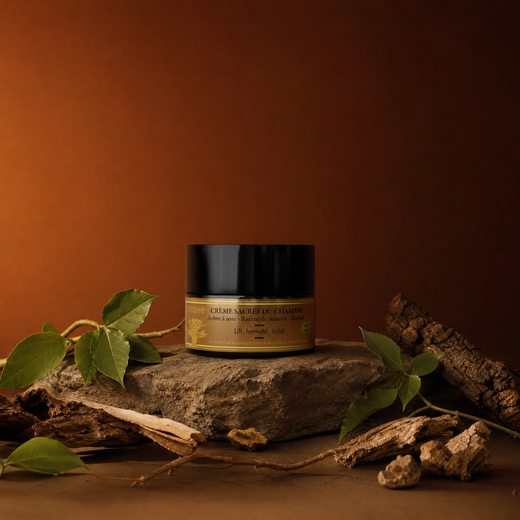
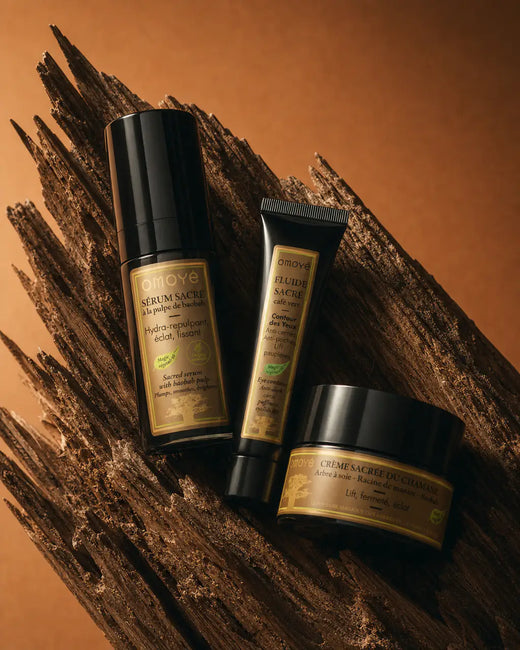
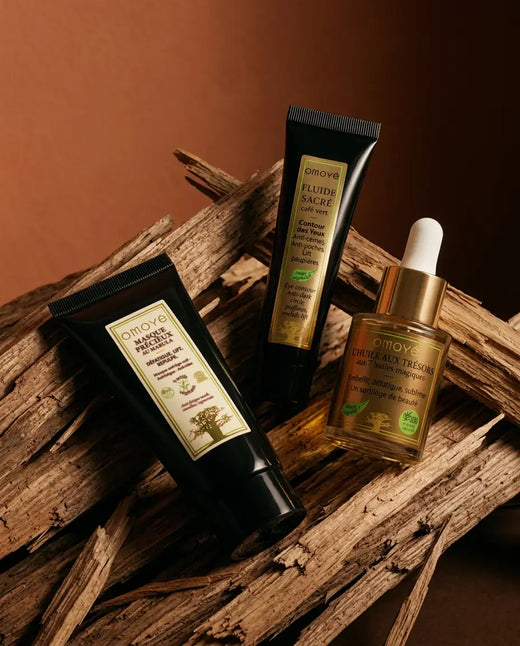
We use it where fatigue is first visible. In the Crème Sacrée du Chamane, silk tree bark extract is the sixth ingredient in the list, before baobab seed oil, squalane, and argan; the cream, a mattifying mousse texture, targets firmness and radiance. In the Fluide Sacré au Café Vert, it is the fifth ingredient, alongside green coffee extract and baobab oil, for the eye contour: dark circles, puffiness, fine lines. Both treatments are combined in the Rituel Sacré Anti-Âge Éclat, along with the Sérum Sacré with baobab pulp. The botanical plate of the silk tree is in the Shaman's Herbarium.
What the studies say
- 2025 review on the pharmacology of Albizia julibrissin: bark rich in lignans and saponins, flavonoids mostly in the flowers, approximately 140 compounds identified. Yang et al., International Journal of Molecular Sciences, 2025
- Bark (He Huan Pi) and flowers (He Huan Hua) are two distinct substances in the Chinese Pharmacopoeia, with use documented since 25 AD. Lu et al., Journal of Ethnopharmacology, 2023
- 26 lignans and phenolic compounds isolated from the stem bark; several inhibit nitric oxide production in vitro. Li et Yang, Molecules, 2020
- Active ingredient manufacturer patent: in vitro, CML reduced by 43% and AGEs on explants reduced by 23.4%; clinical study on 24 volunteers over 2 months, blue component of dark circles down 8.2% vs +4.1% under placebo; self-assessment on 20 volunteers: puffiness -37%, dark circles -40%. Sederma, patent US 9 737 476 B2
- 2012 presentation of the active: "44% improvement in skin fatigue" after 2 months, according to manufacturer tests. Premium Beauty News, 2012
- Review of the Albizia genus: traditional uses documented, but "no clinical evidence" yet supports the health benefits attributed to these plants. He et al., Journal of Ethnopharmacology, 2020
OMOYÉ silk tree skincare
- Crème Sacrée du Chamane: silk tree bark extract in sixth position, mattifying mousse texture, for firmness and radiance (€60 for 50 ml).
- Fluide Sacré au Café Vert: eye contour, silk tree extract in fifth position with green coffee and baobab (€38 for 15 ml).
- Rituel Sacré Anti-Âge Éclat: serum, cream, and eye contour combined, the radiance trio.
Not sure if your skin needs firmness or hydration first? The OMOYÉ skin diagnostic provides the answer in three minutes.
Sources
- Yang Y, Kwon CH, Ham YM, Ha MW, "Pharmacological spectrum of substances derived from Albizia julibrissin Durazz.", International Journal of Molecular Sciences, 2025
- Lu P et al., "A comparison review of Hehuan flowers and Hehuan bark on the traditional applications, phytochemistry and pharmacological effects", Journal of Ethnopharmacology, 2023
- He Y et al., "The ethnopharmacology, phytochemistry, pharmacology and toxicology of genus Albizia: a review", Journal of Ethnopharmacology, 2020
- Li W, Yang HJ, "Isolation and identification of lignans and other phenolic constituents from the stem bark of Albizia julibrissin Durazz", Molecules, 2020
- Chen SP et al., "Structure determination of three saponins from the stem bark of Albizzia julibrissin Durazz", Yao Xue Xue Bao, 1997
- Sederma SA, patent US 9 737 476 B2, "Cosmetic use of an Albizia julibrissin extract and corresponding topical composition"
- Premium Beauty News, "Prodizia, Sederma's new active targets skin fatigue", February 5, 2012
- Sun H, He S, Shi M, "Adjuvant-active fraction from Albizia julibrissin saponins improves immune responses", International Immunopharmacology, 2014
- Wikipedia, "Albizia julibrissin" (botanical identity and history of introduction to Europe)
- Regulation (EU) No 655/2013 laying down common criteria for cosmetic claims (EUR-Lex)
Questions fréquentes
L'arbre à soie et le mimosa, est-ce la même plante ?
Non. Albizia julibrissin est parfois appelé mimosa de Constantinople, mais ce n'est ni le mimosa des fleuristes (Acacia dealbata), ni le Mimosa tenuiflora, dont l'extrait d'écorce figure aussi dans plusieurs soins OMOYÉ. Sur une étiquette, cherchez le nom Albizia Julibrissin Bark Extract.
Peut-on utiliser l'extrait d'arbre à soie sur le contour des yeux ?
Oui, c'est même son usage principal : cernes, poches et fatigue du regard. Chez OMOYÉ, c'est le rôle du Fluide Sacré au Café Vert, à tapoter matin et soir sur le contour de l'œil, paupières comprises.
Au bout de combien de temps voit-on un effet ?
Dans les tests du fabricant de l'actif, les volontaires notent une amélioration du regard dès 7 à 28 jours, et les mesures de cernes et de fermeté portent sur 2 mois d'utilisation quotidienne. Comptez donc un mois pour juger, deux pour conclure.
L'extrait d'écorce d'albizia convient-il aux peaux sensibles ?
Il n'existe pas de donnée publiée d'irritation sur l'extrait seul, et il est utilisé à faible dose, 1 à 3 % en général. La tolérance se vérifie sur le produit fini : testez la crème 48 heures derrière l'oreille avant la première application sur le visage.
Pourquoi OMOYÉ précise-t-il que les données viennent du fabricant ?
Parce qu'aucune étude indépendante n'a encore été publiée sur cet extrait, et que le règlement européen sur les allégations impose de ne pas promettre au-delà de ce qui est démontré. Dire d'où vient un chiffre fait partie de la promesse.
Publié le 5 juillet 2024 · Mis à jour le 8 octobre 2026 · Par Elien Geneste


Comments