
Les plus aimés
Pas sûre ?
Votre routine en deux minutes
Cinq questions sur votre peau, et nous vous disons quels soins lui conviennent. Gratuit, sans engagement.
Faire mon diagnosticOur rituals
Deux ou trois soins qui se répondent
Une association pensée pour un besoin précis, des soins choisis pour agir ensemble.
Tous les rituels Lequel pour moi ?
Serum before or after moisturizer: order and waiting time


The serum is applied before the moisturizing cream. The dermatologist's rule is simple: from the most fluid to the richest. A serum is an aqueous fluid that spreads and absorbs quickly; a cream contains fatty substances that, if applied first, would act as a barrier. The cream then slows down water loss and locks in what the serum has provided. Allow about thirty seconds between the two. In the morning, sunscreen is applied last; in the evening, retinol or acids are placed between cleansing and cream. At OMOYÉ, the order is: mist, Sacred Serum, eye contour, then cream.
In short
- The American Academy of Dermatology states it bluntly: "the order in which you apply your skin care products influences their effectiveness."
- The stratum corneum contains 10 to 30% water; below 10%, the skin is dry. A cream slows down transepidermal water loss, which ranges from 2.3 to 44 g/m²/h depending on the body area in adults.
- A humectant alone (glycerin, hyaluronic acid) can draw water from the dermis without retaining it: this is why it is combined with a fatty substance, i.e., a cream applied afterwards.
- In 76 women over 60 days, a 0.1% hyaluronic acid cream improved hydration and elasticity regardless of its molecular weight; only the 50 and 130 kDa weights reduced wrinkle depth.
- No study establishes a specific wait time between serum and cream; the only delay published by a learned society concerns retinoids: 20 to 30 minutes after cleansing.
Serum before or after cream: the rule and who formulates it
The Cleveland Clinic, in an article reviewed by a dermatologist in 2025, summarizes the morning routine in four steps: cleanser, serums, moisturizing cream, sunscreen; and the evening routine in three: cleanser, retinol or retinoid, moisturizing cream. Their justification: applying a thick cream before a fluid serum means "the serum won't penetrate the skin as well," while the cream "locks in moisture and helps prevent transepidermal water loss."
The American Academy of Dermatology does not use the word "serum" on its page dedicated to the order of skin care, but it establishes the principle: "the sequence in which you apply your products influences their effectiveness," the treatment is applied "right after cleansing," followed by moisturizing cream and sunscreen, then makeup. It specifies elsewhere that vitamin C serum should be applied "after washing your face in the morning, before sunscreen." The French Society of Dermatology does not have a page on the serum-cream order; it does, however, remind of the difference in richness between a lotion, a milk, a cream, and a balm, and advises testing a product on a small area.
Why the cream comes after: humectants, emollients, and occlusives
A moisturizing cream combines three families of ingredients, described in the same way by Harvard Health, the StatPearls manual, and dermatological journals:
- humectants (glycerin, urea, hyaluronic acid, panthenol) draw water from the dermis to the epidermis; they only capture water from the air above 70% humidity;
- emollients (oils, butters) fill the gaps between the cells of the stratum corneum and smooth the skin;
- occlusives (butters, waxes, fatty substances) form a film that slows down transepidermal water loss.
The point that explains the order: a humectant alone "can actually make the skin drier by drawing water into a damaged stratum corneum that doesn't retain it," writes Harvard Health; journals call it a "double-edged sword" and conclude it is "almost always combined with an occlusive." A serum is most often a fluid rich in humectants; the cream applied on top provides the emollients and occlusives that retain the water. For reference, dermatological journals report that a preparation containing at least 5% petrolatum reduces transepidermal water loss by more than 98%; a vegetable-based cream slows it down without canceling it. Useful reminder: the stratum corneum contains 10 to 30% water, skin is dry below 10%, and an adult's transepidermal water loss ranges from 2.3 g/m²/h on the breast to 44 on the armpit.
What is a serum, and what does it really penetrate?
The word "serum" has no regulatory definition: the European cosmetics regulation does not classify textures. In practice, a serum is a water-based fluid or gel, more concentrated in active ingredients than a cream, with little or no fatty substance. It is its texture, not the size of its molecules, that justifies applying it first.
Regarding penetration, two solid facts. The 500-dalton rule: only molecules smaller than 500 daltons truly cross the stratum corneum, which hyaluronic acid or peptides largely exceed. And hyaluronic acid according to its weight: by Raman imaging on human skin, 20 to 300 kDa penetrates the stratum corneum, while 1,000 to 1,400 kDa remains on the surface and forms a moisturizing film there. In 76 women over 60 days, 0.1% hyaluronic acid creams all improved hydration and elasticity compared to a placebo; only the 50 and 130 kDa weights reduced wrinkle depth. A serum therefore acts mainly in and on the stratum corneum, and that is already a lot.
Serum or cream: what is the difference, and are both necessary?
Serum and cream do not do the same job, which is why they do not replace each other. Serum is a light, concentrated fluid that penetrates quickly and targets a specific need: radiance, bounce, fine lines. The cream, which is richer, provides the fatty substances that nourish the skin and retain water on its surface.
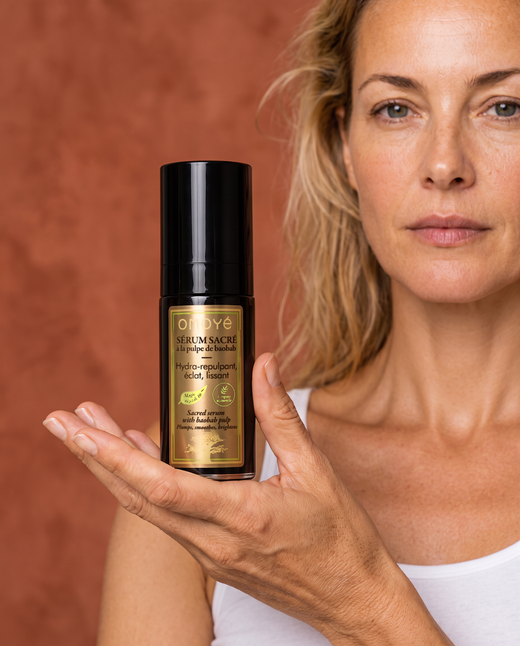
- The serum: fluid texture, little or no fatty substances, a few drops are enough. The Sacred Serum penetrates quickly, without a greasy finish, and leaves the skin hydrated and plumped.
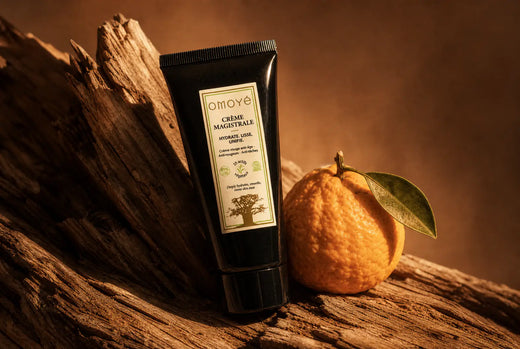
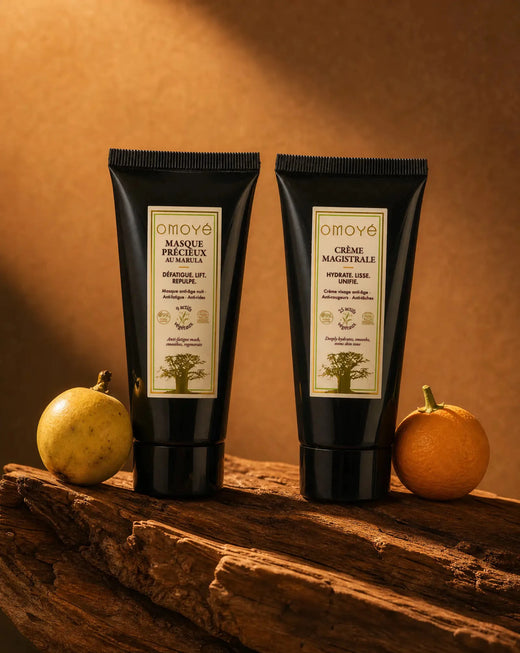
- The cream: denser texture, it nourishes and protects. The Crème Magistrale hydrates and nourishes: the skin remains supple and no longer feels tight.
If you were to keep only one step, keep the cream: it is the one that slows down water loss. The serum is added underneath as soon as you want to go further. This is the entire logic of a facial beauty ritual: few treatments, each in its place.
How long to wait between serum and cream?
No published study sets a time frame, and neither the American Academy of Dermatology nor the Cleveland Clinic provides one. Best practice: let the serum absorb until the skin is no longer damp to the touch, about thirty seconds, then apply the cream. The only specific delay cited by a learned society concerns retinoids: the American Academy of Dermatology advises waiting 20 to 30 minutes after cleansing before applying, as dry skin tolerates it better.
Conversely, it is better to apply moisturizing cream to skin that is still slightly damp, after a shower or after a mist: Harvard Health and the American Academy of Dermatology recommend it to "seal" in the water. This is the role of the Beneficial African Mist before the serum.
With a fluid serum that penetrates quickly, like the Sacred Serum, the delay is short: warm a few drops between your palms, apply to the face, then wait until the skin is no longer sticky before applying the cream. If you layer several serums, follow the same rule, from most fluid to thickest, with a few seconds between each. However, there is no need to wait ten minutes: cream applied to skin that is still fresh better retains the water provided by the mist and serum.
The exceptions: retinol, exfoliating acids, and sunscreen
- Retinol and retinoids: evening only, because they make the skin more sensitive to the sun and can be deactivated by light; start every other night, and apply moisturizing cream afterwards to limit irritation.
- Exfoliating acids (AHAs): evening as well, after cleansing and before the cream. The European Scientific Committee noted 26% of irritation sensations in 100 people with only 0.5% AHAs over six weeks, and the FDA reported an 18% increase in UV-induced redness after four weeks of use. Sun protection the next morning is non-negotiable.
- Sunscreen: always last in the morning, after other treatments and under makeup, 15 minutes before going out. A study of 25 volunteers found no loss of protection when a cream was applied just before or just after; the "sunscreen last" rule remains the dermatological consensus.
Serum before or after night cream, and eye contour?
In the evening, the order does not change: serum first, night cream second. Only the final step may vary. Some evenings, a night mask takes the place of the cream, in a more generous layer; we explain why in our article on the benefits of a night mask.
The eye contour, between serum and cream
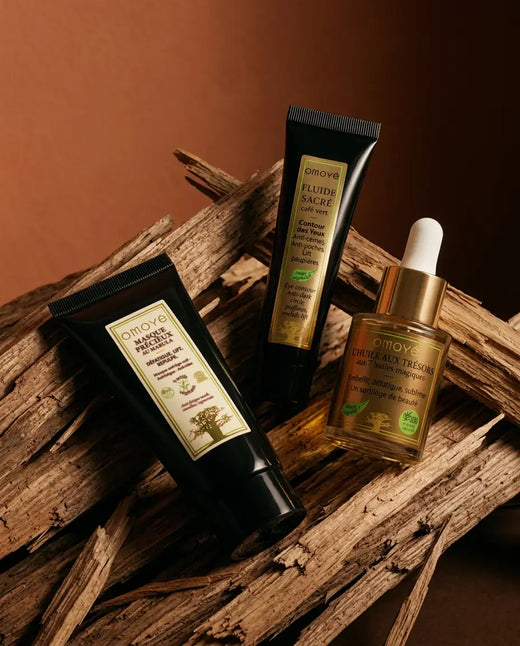
The eye contour treatment is applied after the serum and before the cream. Its texture is fine, made for skin that is itself thinner: applied after a rich cream, it would struggle to do its job. The Sacred Green Coffee Fluid is tapped on with the tip of the ring finger, from the inside to the outside of the eye. Its silky, non-greasy texture melts under the fingers.
And facial oil?
An oil is placed after the serum, on skin that is still slightly damp, and before or instead of the cream depending on the dryness of the skin. It is also the perfect time for a facial self-massage: a few minutes of slow movements before sleeping.
The OMOYÉ ritual, in order
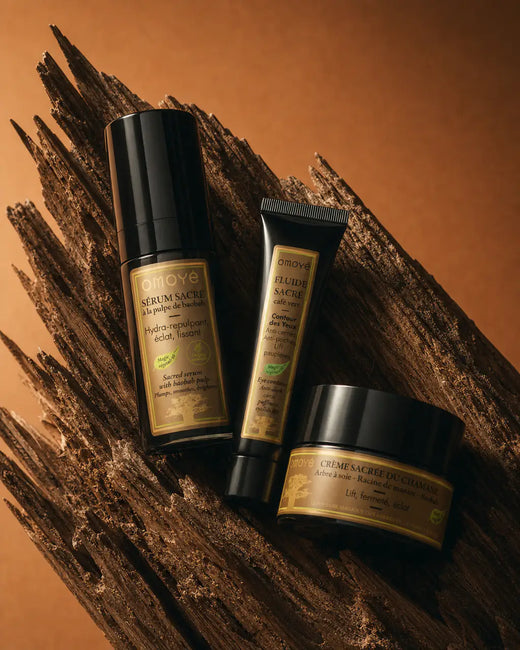
Our textures follow the rule from most fluid to richest. Here is the exact order.
| Step | Morning | Evening |
|---|---|---|
| 1. Cleanse | Water or mist | Kalahari Sensual Cleansing Milk |
| 2. Tone | Beneficial African Mist, which leaves the skin slightly damp | Mist |
| 3. Serum | Sacred Baobab Pulp Serum: aqueous fluid, pulp extract, squalane, glycerin | Sacred Serum, or a few drops of Treasured Oil on slightly damp skin |
| 4. Eye contour | Sacred Green Coffee Fluid, by tapping | Sacred Fluid |
| 5. Cream | Crème Magistrale (all skin types, even sensitive, especially dry and mature) | The same cream, or the Precious Marula Mask as a night mask |
| 6. Protection | Broad spectrum SPF 30 sunscreen, last | Nothing: the skin is working |
One cream, serum underneath, sunscreen on top: three steps are enough for most skin types. The rest is added according to needs, which the OMOYÉ skin diagnostic helps to identify.
What the studies say
- Recommended skin care order by the Cleveland Clinic (reviewed by a dermatologist): cleanser, serums, moisturizing cream, sunscreen in the morning; cleanser, retinoid, cream in the evening; "a thick cream applied before a fluid serum prevents it from penetrating well." Cleveland Clinic, 2025
- "The sequence in which you apply your products influences their effectiveness"; treatment right after cleansing, then cream and sunscreen. American Academy of Dermatology
- Humectants, emollients, and occlusives: a humectant alone can increase water loss, hence its combination with an occlusive; 5% petrolatum reduces transepidermal water loss by more than 98% according to journals. Sethi et al., Indian Journal of Dermatology, 2016
- Meta-analysis of 212 studies: transepidermal water loss in a healthy adult ranges from 2.3 g/m²/h (breast) to 44 g/m²/h (armpit). Akdeniz et al., British Journal of Dermatology, 2018
- 500-dalton rule: molecules larger than 500 Da do not cross the stratum corneum. Bos et Meinardi, Experimental Dermatology, 2000
- Raman imaging on human skin: 20 to 300 kDa hyaluronic acid penetrates the stratum corneum, 1,000 to 1,400 kDa remains on the surface. Essendoubi et al., Skin Research and Technology, 2016
- 76 women, 60 days, 0.1% hyaluronic acid creams from 50 to 2,000 kDa: hydration and elasticity improved for all weights, wrinkle depth reduced only at 50 and 130 kDa. Pavicic et al., Journal of Drugs in Dermatology, 2011
- In 100 subjects, 26% experienced irritation with 0.5% fruit acids over six weeks; 10% glycolic acid over four weeks increases sensitivity to UVB. European Scientific Committee SCCNFP, opinion of June 28, 2000
- After four weeks of alpha-hydroxy acids, UV-induced redness increases by 18%. U.S. Food and Drug Administration, "Alpha Hydroxy Acids", 2022
- In 25 volunteers, the effectiveness of SPF 16 to 63 sunscreens was not altered by a moisturizing cream applied just before or just after. Gálvez et al., Photodermatology, Photoimmunology and Photomedicine, 2022
OMOYÉ treatments, in the order of the ritual
- Beneficial African Mist: the step that moisturizes the skin before serum and cream (€29 for 100 ml).
- Sacred Baobab Pulp Serum: the aqueous serum to apply first, morning and evening (€57 for 30 ml).
- Sacred Green Coffee Fluid: the eye contour, after the serum and before the cream (€38 for 15 ml).
- Crème Magistrale: the cream that seals the serum; it hydrates and nourishes, the skin remains supple and no longer feels tight (€54 for 50 ml).
Not sure if a serum is useful for you, or which cream to choose? The OMOYÉ skin diagnostic answers in three minutes.
Sources
- Cleveland Clinic, "The correct order for skin care products", reviewed by Dr. Sean McGregor, September 5, 2025
- American Academy of Dermatology, "Should I apply my skin care products in a certain order?"
- American Academy of Dermatology, "Dermatologist-recommended skin care for your 20s" (vitamin C before sunscreen, delay before retinoid)
- American Academy of Dermatology, "Retinoid or retinol?"
- Harvard Health Publishing, "Moisturizers: do they work?", 2019
- Harwood A, Nassereddin A, Krishnamurthy K, "Moisturizers", StatPearls, 2024
- Sethi A et al., "Moisturizers: the slippery road", Indian Journal of Dermatology, 2016
- Purnamawati S et al., "The role of moisturizers in addressing various kinds of dermatitis: a review", Clinical Medicine and Research, 2017
- Akdeniz M et al., "Transepidermal water loss in healthy adults: a systematic review and meta-analysis update", British Journal of Dermatology, 2018
- Bos JD, Meinardi MM, "The 500 Dalton rule for the skin penetration of chemical compounds and drugs", Experimental Dermatology, 2000
- Essendoubi M et al., "Human skin penetration of hyaluronic acid of different molecular weights as probed by Raman spectroscopy", Skin Research and Technology, 2016
- Pavicic T et al., "Efficacy of cream-based novel formulations of hyaluronic acid of different molecular weights in anti-wrinkle treatment", Journal of Drugs in Dermatology, 2011
- Ghadially R, Halkier-Sorensen L, Elias PM, "Effects of petrolatum on stratum corneum structure and function", Journal of the American Academy of Dermatology, 1992
- SCCNFP Scientific Committee, opinion on the safety of alpha-hydroxy acids, June 28, 2000
- U.S. Food and Drug Administration, "Alpha Hydroxy Acids", 2022
- Cleveland Clinic, "Facial acids: know what you need in your skin care", 2023
- Gálvez MV et al., "Concomitant use of moisturizers and sunscreens", Photodermatology, Photoimmunology and Photomedicine, 2022
- Dermato-Info, French Society of Dermatology, "Lotion, milk, cream, balm… what’s the difference?"
Questions fréquentes
Le sérum peut-il remplacer la crème hydratante ?
Non. Un sérum est surtout composé d'humectants, qui attirent l'eau sans la retenir ; sans corps gras par-dessus, une peau sèche peut se dessécher davantage. Les peaux grasses ne font pas exception : l'American Academy of Dermatology recommande de continuer à hydrater, avec une texture légère, gel ou mousse.
Huile ou sérum en premier ?
Le sérum aqueux d'abord, l'huile ensuite, la crème en dernier, du plus fluide au plus riche. Chez OMOYÉ, l'Huile aux Trésors se pose sur une peau légèrement humide, seule ou avant la crème, deux ou trois gouttes suffisent.
Faut-il un sérum matin et soir ?
Le Sérum Sacré s'utilise au réveil, ou matin et soir. Le soir, on peut alterner avec quelques gouttes d'huile. Un seul sérum bien choisi suffit : multiplier les produits actifs augmente le risque d'irritation, rappelle l'American Academy of Dermatology.
Où placer le contour des yeux dans la routine ?
Après la crème, en tapotant sur le contour de l'œil, paupières comprises. Le Fluide Sacré au Café Vert s'applique matin et soir, le soir surtout, car c'est la nuit que se forment cernes et poches.
Peut-on mettre une crème par-dessus l'écran solaire ?
Mieux vaut l'éviter : l'écran se pose en dernier, 15 minutes avant de sortir, et le maquillage par-dessus. Une étude sur 25 volontaires n'a pas mesuré de perte de protection avec une crème appliquée après, mais les dermatologues maintiennent la règle par prudence.
Publié le 7 novembre 2024 · Mis à jour le 20 octobre 2026 · Par Elien Geneste


Comments