
Les plus aimés
Pas sûre ?
Votre routine en deux minutes
Cinq questions sur votre peau, et nous vous disons quels soins lui conviennent. Gratuit, sans engagement.
Faire mon diagnosticOur rituals
Deux ou trois soins qui se répondent
Une association pensée pour un besoin précis, des soins choisis pour agir ensemble.
Tous les rituels Lequel pour moi ?
Moringa: what does the "tree of life" really do for the skin?


Moringa (Moringa oleifera) provides two different ingredients for cosmetics. Its seed oil, known as ben oil, is a 74% oleic acid oil that is exceptionally stable and nourishes and increases skin hydration, as measured in a study of 32 participants. Its leaf extract concentrates antioxidant polyphenols (quercetin, kaempferol, chlorogenic acid) and reduced roughness and wrinkles in a 12-week study. At OMOYÉ, moringa seed oil is used in the Soin Souverain Sculptant, our firming body treatment.
In short
- Moringa seed oil contains on average 74% oleic acid and 4.6 to 7.1% behenic acid, the rare fatty acid that gave it its name, ben oil.
- With only 1.2% polyunsaturated fatty acids, it has remarkable resistance to oxidation: its peroxide value remains between 1 and 3 after one year at room temperature.
- In 32 participants, a cream containing moringa oil increased skin hydration compared to the base, with no measured effect on firmness or pigmentation.
- In 11 volunteers over 12 weeks, a cream with 3% leaf extract significantly reduced roughness, scaling, and wrinkles, whereas the base alone had no effect.
- Fresh leaves contain approximately 220 mg of vitamin C per 100 g and up to 10 g of polyphenols per 100 g of dried leaves; these are nutritional values, not a demonstrated skin benefit.
Where does moringa come from?
Moringa oleifera, the only species in its genus to be widely cultivated, originates from the foothills of the Himalayas in northern India, Pakistan, and Nepal. A fast-growing, drought-resistant tree, it is now cultivated throughout Africa, South America, Asia, and the Middle East. Its nicknames reflect its utility: "miracle tree," "tree of life," "drumstick tree" for its pods, and "horseradish tree" for the taste of its roots. In Africa and India, almost all its parts are used: the leaves are eaten and included in local pharmacopoeias, including for the skin; the seeds purify water, a practice documented in both Nigeria and India.
Seed oil has an even older history. Theophrastus, in the 4th century BCE, ranked it first among perfume oils; Pliny and Dioscorides cite it for ointments; perfumers in Grasse used it as a maceration oil until the 1870s, precisely because it almost never goes rancid. Ancient Egyptians were already using it to prepare the skin.
Seed oil or leaf extract: what is the difference?
The two ingredients have neither the same composition nor the same role.
Seed oil (INCI: Moringa Oleifera Seed Oil or Moringa Pterygosperma Seed Oil): the seeds contain 35 to 42% oil. Its profile resembles that of olive oil, with 68 to 80% oleic acid (74% on average), 4.6 to 7.1% behenic acid, 6% palmitic acid, and 5% stearic acid, and only 1.2% polyunsaturated fatty acids. It provides 100 to 280 mg of tocopherols (vitamin E) per kilo depending on the origin, and nearly half of its sterols are beta-sitosterol. Its very low polyunsaturated content explains its stability: nearly 10 hours of resistance in an accelerated oxidation test at 120°C, and a peroxide value still between 1 and 3 after one year at room temperature, whereas the limit set for virgin olive oil is 20.
Leaf extract (INCI: Moringa Oleifera Leaf Extract): fresh leaves provide approximately 220 mg of vitamin C per 100 g (51 to 224 mg depending on maturity and drying), 6.6 to 66 mg of beta-carotene, and up to 10 g of polyphenols per 100 g of dried leaves, dominated by quercetin, kaempferol, and chlorogenic acid. These are nutritional values; for the skin, it is the antioxidant power of the polyphenols that is being studied.
There is also a seed protein extract sold by suppliers for its "anti-pollution" properties; its data is only published in patents, not in peer-reviewed journals.
What do skin studies show?
| Study | Type | Result |
|---|---|---|
| Seed oil cream (Athikomkulchai 2020) | Clinical, 32 participants | Hydration increased compared to base, measured redness decreased; no effect on melanin or visco-elasticity; no irritation |
| 3% leaf extract cream (Ali 2014) | Clinical, 11 men, 12 weeks, half-face | Roughness, scaling, and wrinkles measured by Visioscan significantly reduced; base alone had no effect |
| Same cream, tolerance (Ali 2013) | 48h patch test, 11 volunteers | Non-irritating, reduced erythema |
| Senegal leaf extracts (Baldisserotto 2018) | In vitro + patch test on 20 volunteers | Antioxidant effect confirmed; in vitro SPF of approximately 2 only; no irritation potential |
| Leaf extract on UVB-irradiated keratinocytes (Hengpratom 2025) | In vitro | Free radicals reduced, collagen-degrading enzymes (MMP-1, -3, -9) inhibited, collagen I and elastin preserved |
| Healing (Rathi 2006, Al-Ghanayem 2022, Shady 2022) | Animal (rats, rabbits) | Positive results in animals, not transposable to cosmetic claims |
What this work allows us to say: the oil nourishes and hydrates, and is well-tolerated; the leaf extract is an antioxidant and improved the skin's surface condition in a small university study. What it does not allow: claiming firmness for the oil (not measured), sun protection (an SPF of 2 is not protection), or healing properties.
For which skin types and uses?
Rich in oleic acid, moringa oil is a comfort oil: it softens dry, tight skin or skin stressed by wind, cold, and air conditioning, and its stability makes it reliable in a product meant to be kept for several months. On the body, it is suitable for dry areas and for massage. Skin types looking primarily to strengthen their barrier sometimes prefer to combine it with oils rich in linoleic acid, such as borage, evening primrose, or safflower, which is what our formulas do.
Good to know: moringa leaves, oil, bark, fruit, and flowers have favorable opinions from the FDA, EFSA, and the European CosIng database, and the oil is currently being evaluated by the American Cosmetic Ingredient Review, like other food-grade oils.
In which OMOYÉ product can you find moringa?
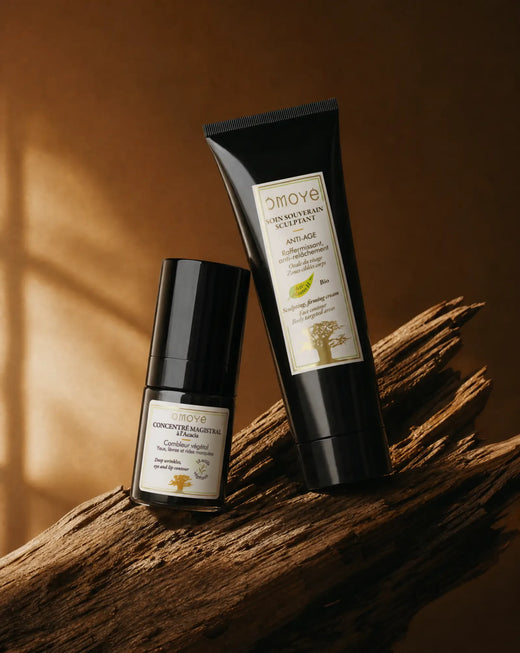
At OMOYÉ, moringa seed oil is an active ingredient in the Soin Souverain Sculptant, our firming body treatment: it appears there under its INCI name, Moringa Pterygosperma Seed Oil, along with jasmine flower water, shea butter, marula oil, and pea extract. The treatment is applied in the morning or evening to areas that lose firmness: stomach, arms, thighs, décolleté, neck. It is currently the only OMOYÉ treatment to contain moringa; our face oils rely on other African trees, primarily baobab and marula. The botanical plate for moringa is in the Shaman's Herbarium.
What the studies say
- Reference review on seeds and oil: oleic acid 73.6% on average (67.8 to 79.5%), behenic acid 6%, 1.2% polyunsaturated, tocopherols and beta-sitosterol, oxidation stability. Leone et al., International Journal of Molecular Sciences, 2016
- Pakistan seed oil: up to 78.6% oleic acid, Rancimat induction period of nearly 10 hours at 120°C. Anwar et Bhanger, Journal of Agricultural and Food Chemistry, 2003
- Oil extracted at different temperatures: 77 to 78% oleic acid, peroxide value between 0.95 and 3 after one year at room temperature. Cervera-Chiner et al., Foods, 2024
- Moringa seed oil cream on 32 participants: increased skin hydration compared to base, no effect on melanin or visco-elasticity. Athikomkulchai et al., Cosmetics, 2020
- 3% leaf extract cream, 11 men, 12 weeks: roughness, scaling, and wrinkles significantly reduced (Visioscan), base alone had no effect. Ali, Akhtar et Chowdhary, Postepy Dermatologii i Alergologii, 2014
- Same cream, 48-hour patch test on 11 volunteers: non-irritating. Ali et al., African Journal of Pharmacy and Pharmacology, 2013
- Leaf extracts: antioxidant activity confirmed, in vitro SPF of approximately 2, no irritation potential on 20 volunteers. Baldisserotto et al., Molecules, 2018
- On UVB-irradiated keratinocytes, leaf extract reduces free radicals and metalloproteinases and preserves collagen I and elastin. Hengpratom et al., Antioxidants, 2025
- 2024 review on nutritional, cosmetic, and medicinal uses of moringa: leaf vitamin C 51 to 224 mg/100 g, polyphenols 1.6 to 12.2 g/100 g dry, favorable opinions from FDA, EFSA, and CosIng. Klimek-Szczykutowicz et al., Frontiers in Pharmacology, 2024
OMOYÉ treatments with moringa, and their companions
- Soin Souverain Sculptant with Moringa: firming body treatment with moringa oil, marula, and jasmine water, for areas that lose firmness (€57 for 125 ml).
- Huile Bienfaisante with Foraha: for face and body, another oil from an African tree, soothing and nourishing.
- Rituel Magistral Ciblé: the Soin Souverain Sculptant with the Concentré Magistral, for body and face.
To find out what your skin needs most, take the OMOYÉ skin diagnostic.
Sources
- Leone A et al., "Moringa oleifera seeds and oil: characteristics and uses for human health", International Journal of Molecular Sciences, 2016
- Leone A et al., "Cultivation, genetic, ethnopharmacology, phytochemistry and pharmacology of Moringa oleifera leaves: an overview", International Journal of Molecular Sciences, 2015
- Klimek-Szczykutowicz M et al., "Moringa oleifera (drumstick tree): nutraceutical, cosmetological and medicinal importance: a review", Frontiers in Pharmacology, 2024
- Anwar F, Bhanger MI, "Analytical characterization of Moringa oleifera seed oil grown in temperate regions of Pakistan", Journal of Agricultural and Food Chemistry, 2003
- Tsaknis J et al., "Characterization of Moringa oleifera variety Mbololo seed oil of Kenya", Journal of Agricultural and Food Chemistry, 1999
- Cervera-Chiner L et al., "Fatty acid profile and physicochemical properties of Moringa oleifera seed oil extracted at different temperatures", Foods, 2024
- Athikomkulchai S et al., "Moringa oleifera seed oil formulation physical stability and chemical constituents for enhancing skin hydration and antioxidant activity", Cosmetics, 2020
- Ali A, Akhtar N, Chowdhary F, "Enhancement of human skin facial revitalization by moringa leaf extract cream", Postepy Dermatologii i Alergologii, 2014
- Ali A et al., "In vivo skin irritation potential of a cream containing Moringa oleifera leaf extract", African Journal of Pharmacy and Pharmacology, 2013
- Baldisserotto A et al., "Moringa oleifera leaf extracts as multifunctional ingredients for natural and organic sunscreens and photoprotective preparations", Molecules, 2018
- Hengpratom T et al., "Moringa oleifera leaf extract ameliorates photooxidative damage and photoaging induced by ultraviolet-B in HaCaT keratinocytes", Antioxidants, 2025
- Popoola JO, Obembe OO, "Local knowledge, use pattern and geographical distribution of Moringa oleifera in Nigeria", Journal of Ethnopharmacology, 2013
- Wikipedia, "Ben oil" (history of ben oil, from Theophrastus to Grasse)
Questions fréquentes
Pourquoi l'huile de moringa s'appelle-t-elle huile de ben ?
À cause de l'acide béhénique, un acide gras saturé rare qu'elle contient à 4,6 à 7,1 %. Théophraste la classait déjà première parmi les huiles à parfum au IVe siècle avant notre ère, et les parfumeurs de Grasse l'ont utilisée jusqu'aux années 1870 parce qu'elle rancit très lentement.
L'huile de moringa protège-t-elle du soleil ?
Non. Les extraits de feuilles atteignent un SPF d'environ 2 en laboratoire, ce qui n'est pas une protection solaire, et l'huile n'a pas de filtre UV. Le matin, appliquez toujours une protection solaire SPF 30 large spectre en dernier.
L'huile de moringa convient-elle aux peaux grasses ?
C'est une huile riche en acide oléique, donc plutôt destinée aux peaux sèches ou au corps. Aucune étude ne mesure sa comédogénicité ; dans l'étude sur 32 participants, la crème qui en contenait n'a provoqué aucune irritation. Sur une peau mixte, mieux vaut la réserver aux zones sèches.
La poudre de feuilles de moringa a-t-elle un intérêt sur la peau ?
Les teneurs en vitamine C et en polyphénols des feuilles sont des valeurs nutritionnelles, mesurées pour l'alimentation. L'étude clinique qui a montré une peau plus lisse utilisait un extrait concentré, dosé à 3 % dans une crème, pas de la poudre appliquée telle quelle.
Quels soins OMOYÉ contiennent du moringa ?
Un seul aujourd'hui : le Soin Souverain Sculptant, soin corps fermeté. Nos huiles et baumes visage n'en contiennent pas ; ils misent sur le baobab, le marula, le foraha et le buriti.
Publié le 11 juillet 2026 · Mis à jour le 9 septembre 2026 · Par Omoyé


Comments
HappyLyfe —
In this blog, the explanation of how moringa supports healthier skin through its antioxidant, nourishing, and regenerative properties while highlighting its role in natural skincare makes it an informative guide for those interested in plant based beauty routines.